Presented by Dr. Stuart Shanker (source: Video) (w/ additions for understanding)
Tags: brain, nervous system, self-control, self-regulation
“The single biggest confusion is between self-control and self-regulation.” – Dr. Stuart Shanker
Have you ever said something to someone, in the heat of the moment, fueled my emotions, that you wished you never said or later regretted? Do you sometimes find it hard to control impulses? Keep reading to understand why.
What Self-Regulation is NOT
- A child/adult making an effort to inhibit their impulses (e.g., the desire to say or do something)
- A child/ adult making an effort to delay gratifying a desire (e.g., The Marshmallow Test)
- These are classic examples of self-control… Why?
- Self-control operates in a different part of our brain from self-regulation
- It operates in the prefrontal cortex which is actually the last part of our brain to develop (it fully develops around 20-24 years old… wow!)
- Self-control operates in a different part of our brain from self-regulation
- These are classic examples of self-control… Why?
- Self-regulation is what makes self-control possible
Here’s how… First let’s understand what self-regulation IS.
Self-Regulation

- Is how we manage stress.
- Stress is anything that requires our internal systems to burn energy to maintain balance.
- e.g., The Marshmallow Test is a stress test
- Stress is anything that requires our internal systems to burn energy to maintain balance.
- It operates in the hypothalamus which regulates our nervous system, which contains two parts:
- Sympathetic: the energy used from stress ⚡
- Parasympathetic: Rest and recovery from that energy used 🔋
- Our nervous system keeps these two in balance
“A holistic understanding of human behaviour begins with a holistic understanding of the human brain.” – Dr. Stuart Shanker
Our “Three Brains” (Paul MacLean)
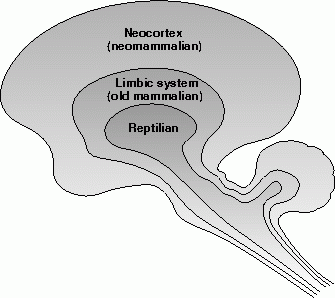
Neocortex: our newest brain
- Where self-control operates
- Responsible for our thinking, reasoning, learning, decision-making 💭
- e.g., When I’m not under a lot of stress, I can think and act clearly 💡
Mammalian (Limbic System): the source of our strong emotions
- Where the amygdala (responsible for making a quick decision of if a stimulus, situation or person (i.e., a stressor) is a threat) is located; if it is, it will activate your stress response (your hypothalamus)
- Where the hypothalamus is located and operates our self-regulation
- e.g., When I’m under stress, my hypothalamus controls my response to the stress
- Ultimately, the amygdala and hypothalamus work together. For example, your amygdala registers a bear is chasing you and that you’re in danger, and your hypothalamus controls your response to the bear chasing you. In this case, it tells you to activate the Reptilian survival response (see below).
- Your responses to any given stressor might include:
- Managing
- Reducing
- Escaping/Fleeing (especially in danger, such as being chased by a bear)
- Your responses to any given stressor might include:
Reptilian: designed to monitor and deal with danger/threat
- Where the brain stem is located
- It is our alarm system that runs 24/7 ⌚
- Is triggered by adrenaline
- Our fight, flight, freeze survival response
- e.g., If I’m being chased by a bear, I don’t have time to think, I need to run! 🏃♂️
What Happens in Fight-or-Flight (Survival Mode) States?
Our brain isn’t always very accurate at making a distinction between whether a stressor (e.g., a stimulus, situation or person) is a perceived or real danger/threat to us because of how quickly it must act:
- e.g.: I am really hungry (internal stimulus) 🍴 vs. I am being chased by a bear (situation) 🐻
Self-regulation and the connections between functions in our brain is what helps us to manage, reduce or escape a stressor:
- e.g.: I am feeling really hungry, I will go eat (stressor is managed/reduced); I am being chased by a bear I will run away (stressor is escaped)
However, if a non-life threatening stressor (such as feeling hungry) becomes too great and we don’t have the ability to alleviate the hunger, or in other cases the coping/managing skills in place to deal with the stressor, our brain believes we are under threat, resulting in our nervous system stepping into survival mode. This makes us unable to focus our attention on anything but what is causing us stress or distress (severe stress). This is very troubling when it comes to everyday tasks such as making decisions and learning, especially for children. Think now about the affect that stress can be having on us all, especially during this time.
- As a result, our brain will start to “shuts down”:
- The Prefrontal Cortex (responsible for thinking and learning): in order to reserve energy to manage or deal with the threat/danger
- Prefrontal cortex = self-control
- As a result, self-control becomes impossible (or very difficult to do)
- e.g., I can’t focus my attention (which is self-control) to what you’re telling me because I am so hungry
- As a result, self-control becomes impossible (or very difficult to do)
- Prefrontal cortex = self-control
- Digestion: in order to divert all our internal energy to the threat/danger
- The two biggest energy burners in the human body are the brain and gut (i.e., when we eat and digest food, our body uses about 10% of energy to break that food down to be absorbed – hence why we might feel tired after a big meal)
- The Immune System: which is vulnerable to stress (see: Immune Stressors), making us more likely to getting sick (e.g., When you travel, if you tend to get sick, it’s your body’s response to being under stress (whether with all the planning/preparing and/or the climate change) which as a result has made your immune system weaker and at a higher risk of catching a cold)
- The Prefrontal Cortex (responsible for thinking and learning): in order to reserve energy to manage or deal with the threat/danger
Back to the Scenario
Now think back to that moment when you were very upset with someone. Feeling upset is what’s considered an emotion stressor. Your amygdala starts to register the person you are upset with as a threat because of the strong emotions you are having towards them at that moment, and thinks you are in danger (hopefully non-life threatening, but your brain does not know that and its only job in this case is to protect you). As a result, your brain and body are using up a lot of energy to deal with this emotional stress, sending you into survival mode. The part of your brain responsible for self-control and the well-thought out things you want say to that person shuts down. In the heat of the moment, fueled by adrenaline, you heart might start racing and you end up speaking from your emotions. Rather than from your rational mind and your emotions, together. These both work together and actually need to be in balance in order for optimal functioning and behaviour. In this moment, you have lost complete ability of self-control (i.e. your filter).
There are many reasons to why we might say or do things to ourselves and others, and understanding our brain is the first step in realizing why. The brain is a very powerful organ and I hope this helps you to understand more about what your brain is capable of. 🧠💪 Thankfully, there are many ways we can train our brain and practice mindfulness and compassion for ourselves and for others, especially in moments such as the one described above. See:
The Foundation of Mindfulness Practice
Establishing a Daily Mindfulness Practice
Interested in learning more about self-regulation?
Dr. Stuart Shanker’s Self-Reg Resources
(Especially for children)
WEBSITE DISCLAIMER
This website is provided only for informational purposes and not intended to be used to replace professional advice, treatment or professional care. Always speak to your physician, healthcare provider or pediatrician if you have concerns about your own health or the health of a child.
 the calm educator