Maximizing School Breaks: Tips for Parents to Help Kids Stay on Track

Early Childhood

Shared by Hazel Bridges

Ms. Bridges is the creator of Aging Wellness, a website that aims to provide health and wellness resources for aging seniors. Sheโ€™s a breast cancer survivor. She challenges herself to live life to the fullest and inspires others to do so as well.


mother and son reading a book
Photo by Ivan Samkov

School breaks are essential for kids to recharge their batteries and relax. However, it is equally important to keep their minds active during this period. Parents can play a crucial role in supporting their child’s academic progress during school breaks. Here is a guide that will explore simple ways parents can help their kids with their studies during school breaks. 

Create a Multipurpose Room 

Creating a study space for your child is a great way to help them stay focused and organized. Consider adding a desk and chair, bookshelves, and a bulletin board to their room, to create a multipurpose room that will not only help your child’s focus but will also increase your house’s appraisal value. It is essential to ensure that lighting is adequate, and the room has minimum distractions. Having a designated study area can make studying more enjoyable, efficient, and effective. 

Encourage Journaling 

Journaling is a great way to practice writing skills and express thoughts and emotions. Encourage your child to keep a journal during school breaks. They can write about their experiences, goals, and aspirations, and reflect on what they’ve learned. You can provide them with prompts or ideas to get them started. This will help improve their writing skills and also encourage self-expression. 

Volunteer Together 

Volunteering is an excellent way to teach kids about empathy, compassion, and community involvement. Research together and find a volunteer opportunity that aligns with your family’s values. Volunteering at a local animal shelter, food bank, or nursing home can be a great way to give back to the community. This will teach your child the importance of social responsibility, empathy, and kindness. 

Practice Public Speaking 

Public speaking is a fundamental skill that can benefit kids throughout their lives. Practicing public speaking during school breaks can help build confidence and improve communication skills. Encourage your child to practice speeches, debates, or presentations on a topic they are passionate about. You can act as an audience and provide feedback to improve their delivery. 

Encourage Reading 

Reading is an essential skill that can improve vocabulary, comprehension, and critical thinking. Encourage your child to read during school breaks, and make it fun by choosing books that align with their interests. Allow them to choose the books they want to read, whether it’s a classic novel or a comic book. Reading together with your child can also be a great bonding experience. 

Organize Playdates with an Educational Twist 

Organizing playdates with other kids can be a fun way to learn and socialize. Consider organizing playdates with an educational twist, such as a science experiment or an art project. This can help kids learn new skills while having fun with their friends. It’s important to ensure that the activities are age-appropriate and safe. 

Practice Problem-Solving 

Problem-solving is a valuable skill that can help kids navigate challenges and make sound decisions. Encourage your child to practice problem-solving during school breaks. You can provide them with puzzles, brain teasers, or math problems to solve. This will help improve their critical thinking, analytical, and decision-making skills. 

Support Your Childโ€™s Development 

Parents can play a vital role in supporting their child’s academic progress during school breaks. Creating a dedicated workspace, encouraging journaling, volunteering together, etc., are all great ways parents can help their kids with their studies during school breaks. These activities not only help kids stay mentally engaged but also teach them valuable life skills that will benefit them throughout their lives. 


What are some ways that you keep your child/ren busy and engaged over breaks? Share them in the comments below!


WEBSITE DISCLAIMER

This website is provided only for informational purposes and not intended to be used to replace professional advice, treatment or professional care. Always speak to your physician, healthcare provider or pediatrician if you have concerns about your own health or the health of a child.


5 Ways to Support Early Literacy Skills

Early Childhood

โ€œChildren are made readers on the laps of their parents.โ€ โ€“ Emilie Buchwald

Earlier this year, the Ontario Human Rights Commission released a Right to Read document on issues affecting students with reading disabilities. While thinking about how schools are opening back next week for children in Ontario, I wanted to share 5 ways that parents/caregivers can begin supporting early literacy skills at home and from an early age.

1. Develop an early love for books: Books can be introduced to little ones, even while they are in the womb! Did you know that in the final trimester of pregnancy, babies become better able at hearing a range of tones, and might even react to the sounds and voices that they hear outside of the womb? If a fetus hears the same melody over and over again, they will likely recognize this sound as a newborn later on. Check out Annie Murphy Paul’s TedTalk on What we learn before we’re born. Instilling a reading routine from a young age and continuing as your child gets older will contribute to strengthening and building their imagination, curiosity and interest in books.

woman reading book to toddler

2. Have books available in the home: Have books that you love to read and a selection of children’s books available. Did you know that children love to imitate the actions of adults? If they witness your love and interest for reading, they too will start to build that interest themselves. The library is also a wonderful place to explore a wide selection of books on shapes, letters, colours, emotions, and so much more. Sometimes I like to put eBooks and eAudiobooks on hold from the Toronto Public Library. Whether you live in Toronto or not, their amazing Ready for Reading program is worth checking out, as it’s filled with lots of great information about children’s early literacy. If you do live in or near Toronto, make sure to check out one of their KidsStop early literacy centres near to you, and get a free library card if you don’t already have one!

books on rack

3. Teach the alphabet: What better way of learning the letters A-Z than through the alphabet song. Talk with your child about the different shape or symbol formation of the upper and lower case letters of the alphabet. Fun ways to explore this can also be from an alphabet puzzle, poster, and especially books. There are many books about the alphabet and lots that are written in more than one language. One of my favourite alphabet books is ABC Mindful Me by Christiane Engel.

white red green and yellow letter letter letter letter letter letter letter letter letter letter

4. Talk often and teach new vocabulary: Long gone are the days when “goo-goo, ga-ga” was used to communicate back to a baby. Young children develop their expressive language, what they say and communicate, both verbally or non-verbally, from their receptive language, what they hear, see and understand from the people around them. Expose your child to a range of new vocabulary and explain to them what complex words in books mean. This will support them when they begin to talk, read and write.

photo of woman and girl talking while lying on bed

5. Play together: Children learn and understand so much about themselves and the world around them through play. With and alongside you, and even through their own independent exploration. Sing rhyming songs, listen to music, play games and activities with letters and words, create your own stories, or simply play pretend. Play materials such as blocks, toys and manipulatives help to develop the muscles in their hands that they will soon need for holding writing tools.

a mother playing ukulele while singing to her daughter

Ever wonder what goes on in a child’s brain while you’re reading together? Check out this video ๐Ÿ‘‡


Additional Resources:

About the Right to Read Inquiry

Encyclopedia on Early Childhood Development – Language Development and Literacy

Zero to Three – Reading Resources

Toronto Public Library – Ready for Reading

Toronto Public Library – Resources for Teachers & Parents

Toronto Public Library – Children’s Books List

Sunnyseed – Book Club

Reading with Littles: Free Tips, Milestones, and Foundational Early Literacy Skills for Babies & Beyond (Thank you for allowing us to share your resources, Sunnyseed!)

The Canadian Children’s Book Centre

Resources for Children with Hearing and/or Vision Needs:

Literacy for Children with Combined Vision and Hearing Loss

Paths to Literacy – Overview of Literacy for Children and Youth Who Are Deafblind

The Outreach Center for Deafness and Blindness – Language and Literacy Resources

National Center on Deaf-Blindness – Literacy


WEBSITE DISCLAIMER

This website is provided only for informational purposes and not intended to be used to replace professional advice, treatment or professional care. Always speak to your physician, healthcare provider or pediatrician if you have concerns about your own health or the health of a child.

The Day I Met Dr. Bruce Perry

Early Childhood

There is no way that I can share my passion and interest around studying, learning about, and understanding child and brain development without mentioning Dr. Bruce Perry, how I met him, and how this journey all began for me. This article is all about the events that led up to the day that I met Dr. Bruce Perry, exactly 6 years ago today.

Read About Me, and one important moment you will learn about my story is that I spent 2 years studying in a program that I eventually came to discover was not for me. Coming from a high school that focused on technology, computer science and business, a significant selection of the courses I was enrolled in at the time were computer/business related, such as accounting, marketing and business leadership. With all of those courses already under my belt, I naturally assumed I would be best suited towards (and most likely to be accepted to) an academic career within the field of business. As a result, it was towards a Bachelors in Human Resources Management (BHRM) that I ventured. By the end of my second year, my marks had taken a further dip. I found myself at the Academic Advising Office with an appointment to discuss my academic pathway options. I shuffled through some old emails and managed to find the original email that was send to me:

Dear Samantha Yarde,

This is a friendly reminder that your appointment to meet with an Academic Advisor
is scheduled for May 25, 2012, 9:00am
Location: Central Square, 103
  

After my appointment with an advisor, the only option I was left with was that I would be withdrawn from the BHRM program, but could enroll into a different business program and re-take a few of the core courses I needed in order to re-enter and continue in the BHRM program. The email that followed 5 days later stated:

Dear student;

Your grade report for the Fall/Winter 2011 academic session indicates that you are ineligible to proceed in your program. As a result, you have been exited from your (BAS, BDEM, BHRM, BPA or BSW) degree program.

And just like that, I was no longer enrolled in the BHRM program and faced with 2 decisions to make:

  1. Continue in another program, bring up my marks, and re-enter the BHRM program at some point. I had already started the program anyways. Or,
  2. Withdraw from the program altogether and reflect on the direction of my future.

I’m sure you know by now the choice I decided to make.

Initially, my plan was to take a year off, do some volunteering, and figure out what I wanted to do with my life. However, it didn’t take long for me to come to terms with exactly what it was I needed to do; which was to follow the passion I had as a child of becoming a teacher. By September 2012, the same year I had withdrawn from the BHRM program, I was already beginning the next chapter of my life. I applied and was accepted into a four-year Bachelor of Early Childhood Leadership program; but, within a couple of days, quickly decided that I didn’t want to make the same mistake twice to end up exactly where I had started. By the second week, I was transferred into a two-year Early Childhood Education program. While those were two really great years of my academic career, I knew that I wanted to continue my studies. In January of 2014, I was nearing graduation. I started thinking about what I wanted to do next and where I wanted to go. The easiest option for me was to stay at George Brown College, and take the bridging courses I needed to transition back into the Early Childhood Leadership program, which I had initially applied to. By this point in my life, I was confident that I wanted to continue pursuing a career within the field of early childhood. So, I thought to myself, why not just continue on, at this school, and with this program? And I probably would have, if it wasn’t for the Career & Education Fair:

“The Career & Education Fair provides opportunities to meet potential employers, explore educational pathways, learn about professional organizations and attend workshops supporting professional development.” (GBC Newsletter, 2014)

The day of the fair, I learned of 2 new paths I could take: I could go on to obtain a Bachelor in Early Childhood Education, or I could apply to the Honours Bachelor of Child Development (BCD) program; which, of course, was the direction I ended up going. Thinking back now, there was something about my course on Infant and Child Development (PSYC1075), and learning all about developmental health, the architecture of the brain, early brain development, neural and sensory pathways, self-regulation, genes and environment, developmental milestones, and so much more that struck my interest. By September of 2014, not only was I enrolled and ready to begin the BCD program, but I had also discovered Dr. Bruce Perry and of his work, while he was a guest on the Oprah Winfrey Show, many years ago. I recall him mentioning a book he had published in 2006 titled, The Boy Who Was Raised as a Dog: And Other Stories from a Child Psychiatrist’s Notebook–What Traumatized Children Can Teach Us About Loss, Love, and Healing. Captivated to continue learning more, I decided to order a copy of this book.

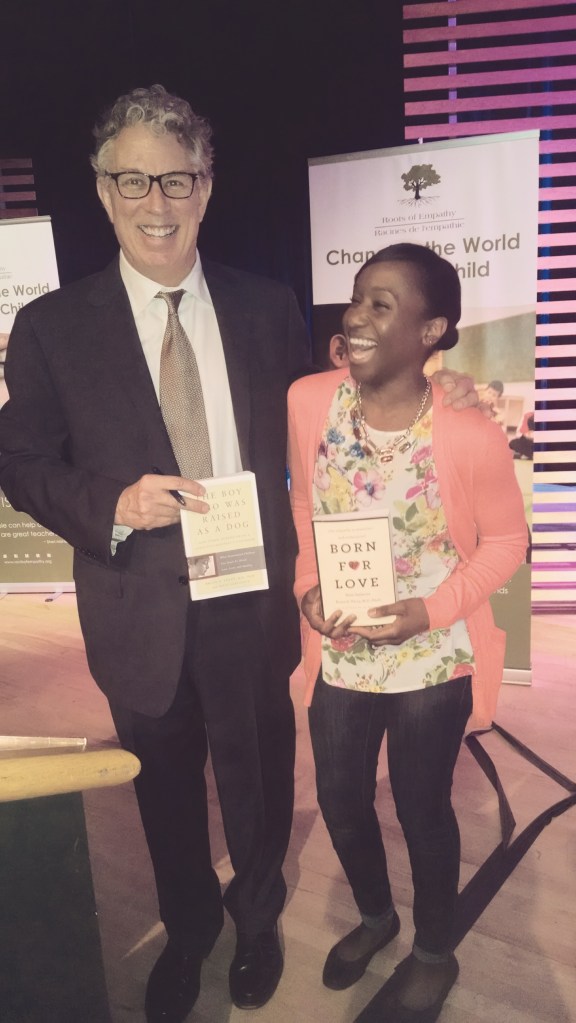
Meeting Dr. Bruce Perry on May 11, 2015 at the Roots of Empathy Research Symposium

Over the following two and a half years in the BCD program, not only would I be required to read this same book for one of my courses, but I’d also be invited by one of my professors to an event that Dr. Perry would be speaking at. Fast forward to May 11, 2015, where I’d be sitting alongside my peers at the Roots of Empathy Research Symposium in Toronto, Canada. That day, exactly 6 years ago today, I had the chance to meet one of my greatest inspirations in the field. Back in 2014 when I finally had a clearer idea of what I wanted to do with my life and what I was most passionate about, Dr. Perry further opened the doors to my interest in child and brain development, neuroscience, trauma and the importance of early childhood experiences. This brings me to the 2 reasons why I wanted to write and share this article with you:

  1. The Roots of Empathy will be hosting their 2021 Research Symposium on May 11th (today! what a coincidence) & 12th from 1:00-3:00 PM ET. It is virtual, free and open to the public. This event will bring together neuroscientists, psychiatrists, and experts on empathy like Dr. Richard Davidson, Dr. Dan Siegel, and of course, Dr. Bruce Perry.
  2. Dr. Bruce Perry and Oprah Winfrey are co-authors of a new book titled, What Happened to You? Conversations on Trauma, Resilience, and Healing, which was released on April 27th and is a #1 New York Times Bestseller.

While I won’t be able to attend the Roots of Empathy Research Symposium this year, I share it with the hopes that you might be able to attend and learn from it, as well as share it with others. I did, however, attend one of Perry and Winfrey’s virtual book tours and look forward to continuing reading What Happened to You? I can already see that it is making a significant impact on the world, and the ways that we view and understand early childhood experiences, brain science, trauma and healing. Have you gotten your copy yet? ๐Ÿ“–


Interested in learning more about Roots of Empathy?


Interested in learning more about the What Happened to You?


WEBSITE DISCLAIMER

This website is provided only for informational purposes and not intended to be used to replace professional advice, treatment or professional care. Always speak to your physician, healthcare provider or pediatrician if you have concerns about your own health or the health of a child.