7 Ways to Try and Get Kids to Eat their Veggies

Early Childhood, Health & Lifestyle
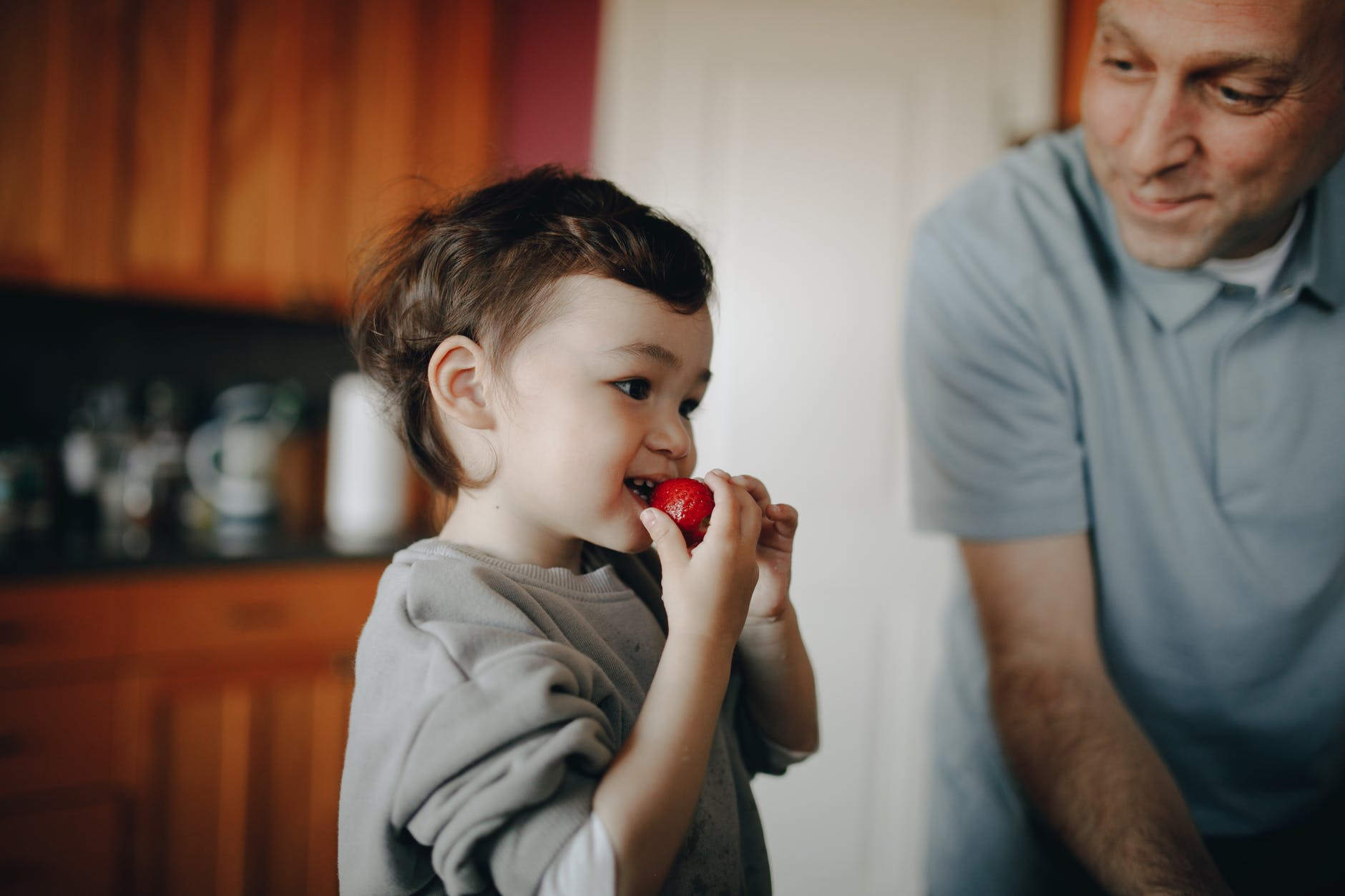
a child eating strawberry beside her father
Photo by PNW Production

Working with young children, I know just how hard it can sometimes be to get them to simply try and hopefully jump at the thought of eating vegetables at snack and mealtimes. I can only imagine how hard it may be to do this at home. So, if you’re struggling in this area, here is a list of 7 ways you could try to get your kids to eat those veggies: 

1. Begin as early as possible: As soon as your little one is ready to begin eating solid foods is a great time to introduce vegetables. Cut them up small, puree them, whatever you need to do. Because we all know just how good vegetables are for us! Plus, there is so much that can be taught to kids about healthy eating at a young age when they are interested in every single thing.

2. Explore with all senses and make it fun: Don’t expect them to love vegetables right away or rush the process. If there’s some hesitation, begin by simply touching, smelling, and tasting (or licking) them. Slowly work their way up to (hopefully) eventually eating them. Talk about the crunch carrots make when you bite into them or the squishiness of tomatoes.

Photo by August de Richelieu

3. Use them in dishes and invite kids into the kitchen: There are so many different meals that can be made with vegetables! Try making a vegetable stir-fry, tomato soup or cauliflower rice. The flavour added from a little salt or pepper can help to mask the taste that some kids just don’t seem to like. Get them to help out with the cooking process, even if it’s with washing the vegetables or sprinkling the seasoning. 

4. Keep trying!: It takes time to acquire a liking to something new. Don’t give up after the first try. Introduce the broccoli or cucumber more than once with a variety of meals, such as with rice one day and then pasta on another occasion. 

5. Set an example and limits: Kids, especially at a young age like to imitate the actions and behaviours of the adults in their lives. If they see you eating them, there’s a chance they’ll be willing to give them a try. If they see something else more appealing advertised on TV, they’ll probably want that instead. So keep that in mind too! 

6. Talk with them: Kids understand everything that goes on around them and learn quickly! Spend time having conversations with them about healthy eating habits and what hungry and satiety feel like. Take pauses at mealtimes for conversations and to slow the process of eating down in order to enjoy the food and the time spent together.

7. Smoothies: We saved the best for last! Smoothies are a great way for kids to get the most fruits and veggies in the shortest amount of time. Not only are smoothies tasty and colourful, they are healthy, fun and super easy to make! Throw in some baby spinach along with blueberries and a banana and voilà! But maybe those fruits and vegetables don’t even last a week in your house before they go bad. Or, maybe you want to top up on your kids already existing vegetable intake. Well, you’ve come to the right place. Add SMOOV Superfood Blends’ Healthy Kids Bundle to your cart and just make sure you have some water or milk at home for when our bundle arrives to you. You can even add their superfood blends to that Spinach Blueberry Banana smoothie. That’s simply all you need to get those veggies in, plus your kids and you will enjoy it! Don’t forget to always make it fun: talk about the loud sound the blender makes! 


This article was written for SMOOV Superfood Blends.

Are you’re looking for an easy way to get your greens in, boost your immunity, energy or mood? SMOOV Superfood Blends is a Canadian-based company that carries a variety of healthy, organic and all-natural superfood blends powder. Visit SMOOV today!


WEBSITE DISCLAIMER

This website is provided only for informational purposes and not intended to be used to replace professional advice, treatment or professional care. Always speak to your physician, healthcare provider or pediatrician if you have concerns about your own health or the health of a child.

Flow is Happiness & Children’s Play

Early Childhood

Photo by cottonbro

Flow is a concept that was identified by a psychologist by the name of Mihaly Csikszentmihalyi. In researching happiness and creativity, he found that people were happiest in this state. Flow is defined as:

The mental state of operation in which a person performing an activity is fully immersed in a feeling of energized focus, full involvement, and enjoyment in the process of the activity. Wikipedia

Flow can also be described as “being in the zone” and can occur in activities such as playing a sport or music, writing, dancing, baking, and even while working, learning or creating.

Photo by Jansel Ferma

The characteristics of Flow include:

Positive Psychology

  1. Complete concentration
  2. Having a clear goal and reward in mind
  3. Experiencing a transformation of time as either going fast or slow
  4. Feeling that the task is intrinsically rewarding
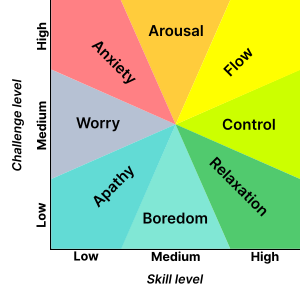
  5. A balance between the level of challenge of a task and your skill level
  6. A feeling of control over the task
  7. Losing sense of self or self-consciousness
  8. A desire to repeat/continue the task

In reference to #5, Flow can’t happen if a task is too easy or too difficult. There needs to be a balance between how challenging a task is and your skill level. For example:

Photo by Wikipedia
  • If the challenge of a task is low (too easy) and your skill level is high in relation to the task, it can lead to boredom
  • If the challenge of a task is high (too difficult) and your skill level is low in relation to the task, it can lead to anxiety

Children can experience Flow at a young age, particularly during their play which is something they naturally love to do. Think back to a time from your childhood when you were so absorbed in playing that you didn’t even realize how much time had passed. What exactly was it you were doing?

If you experienced Flow as a child, it’s likely that:

  1. You concentrated on what you were doing, undisturbed by what was happening around you  
  2. You were intentional in your play, often with a desire to see things through to completion 
  3. You lost awareness of how much time had passed
  4. You felt proud and a sense of accomplishment in what you did or discovered
  5. You were persistent in your play because you were curious, interested, it was challenging enough and it matched your skill level
  6. You were actively in control of what you were doing/accomplishing
  7. You lost awareness of internal cues (e.g., not realizing that you were hungry or tired)
  8. You desired to repeat the experience again

Can you recall specific moments from your childhood when you experienced/felt any of these?

Maybe there are moments now. What moments are those?

Here are a few benefits to children experiencing Flow:

Photo by cottonbro
  • Children learn best when they are curious (which they naturally are), interested in learning something, and have choices and options
  • Children are continuously learning to understand themselves. Skill level, what is deemed as challenging, and states of Flow will differ for each child. When children are in a state of Flow, they are in control of what they are doing (behaviour and actions) which nurtures their ability to self-regulate and persist through experiences that are challenging, age-appropriate and matches their skills and abilities
  • Play is viewed as children’s work. What this means is that through play, children are naturally engaging in learning experiences that improve their skills, strengthen their capabilities and grow their self-development
  • In uninterrupted states of Flow, children can stretch themselves to great possibilities
  • When nurtured, Flow can turn into a child’s lifelong passion, profession and interest

I hope there were moments from your childhood when you experienced Flow.

If quarantine didn’t lead you to discover it again, I hope that you might find or experience something that does.


WEBSITE DISCLAIMER

This website is provided only for informational purposes and not intended to be used to replace professional advice, treatment or professional care. Always speak to your physician, healthcare provider or pediatrician if you have concerns about your own health or the health of a child.
Attachment Styles

Early Childhood

A lasting psychological connectedness between human beings.” – John Bowlby


Humans are social beings. From the moment we are born, we enter a world filled with people. Babies make sense of their world through the relationships and interactions they have with their primary caregivers. This is how an attachment is formed and generally this takes place within the first year of life. An attachment is an emotional bond with another person. It can be formed with a child, parent, friend, teacher or student.

Attachment Theory.

At the heart of evolutionary theory of attachment is a psychiatrist by the name of John Bowlby. His work at a clinic in the 1930s with children who were emotionally disturbed led him to explore the importance of the mother-child relationship in children’s earliest stages of development. Bowlby noticed that children showed great distress when separated from their mothers and that they represented a source of security for the child to explore and engage with the world. He suggested that this mother-child relationship sets the template for which children will view future social relationships they encounter later in life. He believed the window for attachment to develop is from birth to 5 years of age and if an attachment is not established within this time, there are consequences to a child’s development (McLeod, 2017).

Attachment Styles.

At the heart of attachment styles is a psychologist by the name of Mary Ainsworth. She was interested in investigating the varying styles of attachment among children. Ainsworth devised an experimental study in the 1970s called the Strange Situation which observed the interaction between a mother and child in a room, the behaviour and reaction of the child when a stranger entered the room, when the mother left the child with the stranger and then when she returned. The results from the study yielded three main attachment styles among 1 to 2-year-old babies:

Secure – The attachment figure is a safe base (a source of safety, security and comfort) for the child to freely explore and in times of distress. When a child feels a sense of safety and security they will feel comfortable with exploring and interacting with their environment. The child is easily soothed when the mother leaves the room and returns. The attachment figure is overall available, caring, attuned, consistent and responsive to the child’s needs (McLeod, 2018).

Insecure-Avoidant – The child is physically and emotionally independent of the attachment figure. The attachment figure is not sought out by the child during distress when the mother leaves the room and returns. The attachment figure is likely unavailable, insensitive and rejecting of the child’s needs (McLeod, 2018).

Insecure Ambivalent/Resistant – The child displays clingy, dependent behaviour towards their attachment figure. The child does not feel a sense of security from their attachment figure and is hard to soothe and feel comforted when in distress. The attachment figure is considered inconsistency in their responsiveness to the child’s needs (McLeod, 2018).  

The level of sensitivity and responsiveness that a caregiver displays plays a role in the type of attachment style a child will develop and the way in which the child will view themselves and their worth as they grow older and into an adult. Children who have a secure attachment may likely develop a positive outlook, seeing themselves as worthy of care and respect, and may view others as trusting and helpful. A secure attachment tends to lead to healthy self-regulation and coping skills and the development of future relationships that have a balance of intimacy, independence, reliability and trust (McLeod, 2018).

Children with an avoidant attachment style may likely to view themselves as devalued, unworthy and unacceptable due to the rejecting nature of their caregiver. As an adult, they may be emotionally distance from others, fear closeness, intimacy and being vulnerable, as a means of protecting themselves from getting hurt. They may view the world as unreliable, leading them to be self-reliant, self-dependent and protective (McLeod, 2018).

Children with an ambivalent/resistant attachment style may likely have a negative self-image, be angry and confused and seek out ways to gain attention. They may be disinterested and anxious towards others and struggle with forming strong and positive emotional connections. They may also have feelings of insecurity, be overdependent and always seek approval from others (McLeod, 2018).

While a caregiver’s level of sensitivity is one factor, there are many other factors that can influence a child’s attachment style such as their temperament and experiences. Ultimately, early attachment sets the template for the future development of relationships later in life. This is why it’s important that families, parents/caregivers and provided and offered with supports to ensure the healthy development of their child’s social-emotional and overall development.


References

If you are interested in exploring attachment theories further, I have referenced a couple of links below where you can find more information:

Attachment (City of Toronto)

John Bowlby – Attachment Theory; Stages of Attachment:

McLeod, S. A. (2017, Feb 05). Attachment theory. Retrieved from https://www.simplypsychology.org/attachment.html

Mary Ainsworth – Strange Situation:

McLeod, S. A. (2018, Aug 05). Mary Ainsworth. Retrieved from https://www.simplypsychology.org/mary-ainsworth.html


WEBSITE DISCLAIMER

This website is provided only for informational purposes and not intended to be used to replace professional advice, treatment or professional care. Always speak to your physician, healthcare provider or pediatrician if you have concerns about your own health or the health of a child.

Brain Development in the Early Years

Early Childhood

Early experiences affect the development of brain architecture, which provides the foundation for all future learning.” – Center on the Developing Child


man in gray shirt holding baby in white onesie
Photo by nappy

If you haven’t already read What is ECD? it’s a great place to start as topics mentioned there will relate to what I’ll discuss here. As I mentioned in that article, the first 3 years of a child’s life is the most important. Relationships and experiences play a significant part in the earliest years as it is ultimately where it all begins. Experiences are created through relationships and it is how a young child learns. Nurturing and supportive experiences (through serve and return) repeated overtime with the caregivers in a child’s life eventually forms a healthy, secure attachment which is bounded by a feeling of trust and security. These repeated experiences and type of relationships all get build into the architecture of the developing brain (see: “More on Brain Development” below). A secure attachment is formed when a child has learned that they can trust that their needs will be consistently met, and they feel a sense of safety and protection with their caregivers. There are also 2 other types of attachment styles. The type of relationship a child has established from the beginning sets the template for how they will view future relationships. This template is known as their internal working model. When a child learns that both they and their needs are important and will be met, this contributes to the later development of many future competencies, including how they feel about themselves, their attitude towards learning and others, the types of relationships they will continue to form, and even how they understand and interpret their own emotions and that of others.

It’s important that future relationships, especially those that are formed outside the context of the family and home, are also sources of trust and safety; such as when a child enters school and is exposed to opportunities to develop relationships with their peers and teachers. Children learn best through relationships in all contexts. A child will continue to learn things such as people have needs, feelings and thoughts that are different than their own, such as in situations that may require them to share or wait their turn. In school, when a child has established a positive relationship with their teachers and peers, they are more likely to be eager to learn, attend, and be successful in school. The positive relationships and experiences early in their life lay the foundation for hopefully new positive relationships, experiences and learning to form. If a child is going to school not feeling happy and excited to learn, there is possibly a reason why and it’s important to pay attention to that.  

I understand that brain development in the early years is a very board topic which is why I’ve kept this article short. As I continue to publish more posts, you will learn from a range of topics that contribute to an understanding of how children grow and develop into adulthood. The two things I want you to take away from this article is the importance of early relationships and experiences. These both play a large part in present and future development but do not operate in isolation. It’s important to acknowledge that there are a range of other factors that contribute to development. These will also appear in future posts. So, stay tuned, as I hope to continue sharing with you.


More on Brain Development


The Brain Architects Podcast: Brain Architecture: Laying the Foundation


WEBSITE DISCLAIMER

This website is provided only for informational purposes and not intended to be used to replace professional advice, treatment or professional care. Always speak to your physician, healthcare provider or pediatrician if you have concerns about your own health or the health of a child.

What is ECD?

Early Childhood

Let’s raise children who won’t have to recover from their childhoods.” – Pamela Leo


photo of family sitting on floor while reading book

Early Childhood Development, (often referred to as ECD), is the development that occurs within a child’s life from 0-8 years of age. This is a time of rapid growth in the social, emotional, cognitive, linguistic, and physical development of a child. This all takes place in the context in which a child is developing such as the home, child care centre and/or community.

But what exactly is happening during ECD?

The most important and crucial time of a child’s development is essentially the first 3 years of their life. But why is this? Well, during this stage of development, there are 1 million new neural connections every second that are happening in the brain when a baby learns and makes sense of their environment and everything that is happening around them. The genetics that a baby is born with also play an important role as well. Genetics, early experiences, interactions and relationships with the people in their life, as well as the environment in which they live, all interact and influence the quality and architectural foundation of the developing brain. The development of a solid and sturdy foundation is optimal.

photo of man in raising baby under blue sky

So, how is a solid and sturdy foundation built?

A solid and sturdy foundation is built through serve and return interactions (see: “More on Serve & Return” below). This consists of the back-and-forth interactions between a young child and an adult. When a child uses facial expressions, babbling and gestures to interact, serve and return consists of the level of sensitivity in the actions, gestures, eye contact and words that an adult uses to appropriately respond to the child and their needs. During serve and return interactions, neural connections in a child’s brain are being made, strengthened and ultimately set the foundation for the development of future communication and social skills.

What happens when there is little to no serve and return interactions happening between a child and an adult?

When there is a lack of serve and return maintained by the adult or their responses are inconsistent and/or inappropriate, this contributes to creating a weak foundation, possibly an insecure attachment, resulting in the architecture of a child’s brain not developing as it should. Consequently, this impacts their learning, behaviour and development, and could lead to long-term health and developmental issues. At its earliest development, the human brain is “plastic”, meaning it’s malleable, flexible and easier to change. Over time, connections from experiences and interactions that are repeated and “hardwired” into the brain become harder to reverse. Long-term experiences and interactions that lack serve and return become harder to repair later.

How does a sturdy foundation impact future development?

Not only does serve and return build a sturdy foundation, it also fosters a baby’s social and emotional development. When a baby cries, she may be easily comforted by her caregiver’s touch. When a baby babbles, he learns new words from his caregiver’s gentle and calm responses. When these early experiences are happening, they positively influence the development of future, more complex, emerging and interrelated abilities that build on top such as cognition and language (see: The Science of Early Childhood). These are skills that become essential when a child enters school.

So, what does all this mean?

crop anonymous black mother holding hand of baby lying on bed

Early childhood is a time of rapid development, growth and potential. When a sturdy social and emotional foundation is not established, which includes the development of self-regulation (which an adult plays a crucial role in helping a child to develop), a child will have difficulty developing more complex skills. For example, a child who struggles with regulating their emotions because they did not have the experiences with an adult that would have helped to foster the development of this may have a challenging time remaining focused at more complex skills and tasks. The type of foundation that is set during this time is so important and fundamental to the successful future development of a child. When a sturdy foundation is established through the care, interaction and response of an adult, a child has the capacity to build upon the development of necessary future skills.

Let’s ensure that children’s early childhood is a time of great care, attention and understanding. Let’s get it right from the start. As Pamela Leo said, “Let’s raise children who won’t have to recover from their childhoods“.


See: Brain Development in the Early Years to continue reading.

Visit: Self-Regulation: A Parent’s Guide for more on self-regulation.


More on Serve & Return


Visit: 5 Steps for Brain-Building Serve & Return


The Brain Architects Podcast: Serve and Return: Supporting the Foundation


WEBSITE DISCLAIMER

This website is provided only for informational purposes and not intended to be used to replace professional advice, treatment or professional care. Always speak to your physician, healthcare provider or pediatrician if you have concerns about your own health or the health of a child.