
Photo by cottonbro
Flow is a concept that was identified by a psychologist by the name of Mihaly Csikszentmihalyi. In researching happiness and creativity, he found that people were happiest in this state. Flow is defined as:
The mental state of operation in which a person performing an activity is fully immersed in a feeling of energized focus, full involvement, and enjoyment in the process of the activity. Wikipedia
Flow can also be described as “being in the zone” and can occur in activities such as playing a sport or music, writing, dancing, baking, and even while working, learning or creating.

The characteristics of Flow include:
- Complete concentration
- Having a clear goal and reward in mind
- Experiencing a transformation of time as either going fast or slow
- Feeling that the task is intrinsically rewarding
- A balance between the level of challenge of a task and your skill level
- A feeling of control over the task
- Losing sense of self or self-consciousness
- A desire to repeat/continue the task
In reference to #5, Flow can’t happen if a task is too easy or too difficult. There needs to be a balance between how challenging a task is and your skill level. For example:
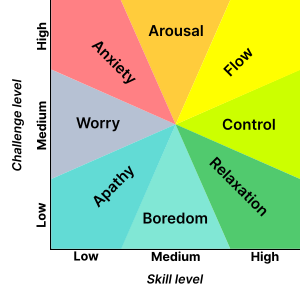
- If the challenge of a task is low (too easy) and your skill level is high in relation to the task, it can lead to boredom
- If the challenge of a task is high (too difficult) and your skill level is low in relation to the task, it can lead to anxiety
Children can experience Flow at a young age, particularly during their play which is something they naturally love to do. Think back to a time from your childhood when you were so absorbed in playing that you didn’t even realize how much time had passed. What exactly was it you were doing?
If you experienced Flow as a child, it’s likely that:
- You concentrated on what you were doing, undisturbed by what was happening around you
- You were intentional in your play, often with a desire to see things through to completion
- You lost awareness of how much time had passed
- You felt proud and a sense of accomplishment in what you did or discovered
- You were persistent in your play because you were curious, interested, it was challenging enough and it matched your skill level
- You were actively in control of what you were doing/accomplishing
- You lost awareness of internal cues (e.g., not realizing that you were hungry or tired)
- You desired to repeat the experience again
Can you recall specific moments from your childhood when you experienced/felt any of these?
Maybe there are moments now. What moments are those?
Here are a few benefits to children experiencing Flow:

- Children learn best when they are curious (which they naturally are), interested in learning something, and have choices and options
- Children are continuously learning to understand themselves. Skill level, what is deemed as challenging, and states of Flow will differ for each child. When children are in a state of Flow, they are in control of what they are doing (behaviour and actions) which nurtures their ability to self-regulate and persist through experiences that are challenging, age-appropriate and matches their skills and abilities
- Play is viewed as children’s work. What this means is that through play, children are naturally engaging in learning experiences that improve their skills, strengthen their capabilities and grow their self-development
- In uninterrupted states of Flow, children can stretch themselves to great possibilities
- When nurtured, Flow can turn into a child’s lifelong passion, profession and interest
I hope there were moments from your childhood when you experienced Flow.
If quarantine didn’t lead you to discover it again, I hope that you might find or experience something that does.
WEBSITE DISCLAIMER
This website is provided only for informational purposes and not intended to be used to replace professional advice, treatment or professional care. Always speak to your physician, healthcare provider or pediatrician if you have concerns about your own health or the health of a child.
 the calm educator