5 Tips for Teachers to Start the School Year Grounded

Early Childhood, Self-Regulation

With back-to-school around the corner or having already started (depending where you are in the world), it tends to often come with a mix of anticipation and anxiety; not only for teachers, but for students and parents as well. Whether you’re returning to the same classroom or stepping into a new role, this time of year can bring a rush of emotions and an ever-growing to-do list. As teachers, we prepare materials and plan lessons, but it’s just as important to prepare ourselves for the year ahead.

Here are five grounding tips to help teachers start the school year with clarity, confidence, and care for both themselves and their students.

1. Begin With Check-Ins – Before you start setting up your classroom or organizing your lesson plans, take time to check-in with yourself. What will allow you to feel grounded and present this year? Is it quiet mornings? A new boundary around after-hours work? A daily walk before school starts? Creating even a small check-in ritual can help you anchor into the moment before the full pace of school life kicks in.

Before the school year begins, I like to start getting myself into a routine. For me that means getting to sleep earlier, and waking up feeling well rested so that I can start my day with some gentle movement. That way when the first day of school arrives, I’m already feeling grounded and prepared for the exciting and busy day ahead.

What helps you come back to yourself when things feel chaotic? What helps your students?

alphabet class conceptual cube
Photo by RDNE Stock project

2. Set the Tone With Intention– It’s tempting to want everything to be “just right” on the first day, but what’s more important is your presence. Set your tone for the year by showing up as someone who is real, warm, and responsive, and not someone who’s holding it all together at the expense of their own well-being. Whether it’s your classroom environment or your teaching style, let your values guide the tone you set.

As each new school year arrived, I began to realize that the most important thing instead of wishing the day would go perfectly, was to just let it unfold as it would. Many of my preschool students would cry as they adjusted to their new school routine. What was important was that they felt safe and attended to. Not so much that they had participated in the first day of school activities.

How do you want your students to feel in your classroom and how can you model that for them?

Photo by cottonbro studio

3. Build Routines That Work for You – Structure matters for students and teachers. Think about your daily rhythms, not just your schedule. Do your current routines energize or exhaust you or your students? Are there small shifts you can make to create smoother transitions or calmer mornings? Consistency doesn’t mean rigidity. It means developing patterns that support both teaching and living well.

I always found that it took a few weeks of everyone settling, adjusting to a new school year, classroom and cohort, before a smooth flow was established. It took time to determine what was and wasn’t going to work with my classroom depending on the needs of my students. Some years required a bit more movement integrated into the day, while others a more slower pace and supportive transitions.

What routines help you and your students feel steady and supported throughout the day?

Photo by Yan Krukau

4. Nourish Connection First – Relationships are the heart of any classroom. Before diving into academics, invest time in establishing trust, safety, and joy. Whether you’re welcoming back returning students or meeting a new group, slowing down to build connections will make the learning stick later on.

Without making space and taking the time to get to know my students, build a relationship with them, and a level of safety and trust, there would be very little room for much learning to take place. Beginning of school year activities such as Star of the Week gave my students the opportunity to learn about one another.

How can you create more moments of genuine connection in your classroom each day?

5. Give Yourself Permission to Evolve – You’re not the same teacher you were last year and that’s a good thing! Maybe your priorities have shifted. Maybe you’ve learned what you don’t want to carry forward. Let yourself grow and try new approaches. You don’t need to recreate the past and you’re allowed to reimagine what works for you now.

With a little over ten years of experience working with children, I’ve been able to look back and see just how much I have grown. I’ve learned many lessons along the way and different ways of doing things. By no means do I consider myself an expert. When I open myself up to continuing to learn and evolve in my role, I can bring the best version of myself to my classroom in order to best support my students.

Think about what you have learned about yourself as an educator over the past year(s). What are you ready to leave behind and what are you ready to lean into?

The start of a new school year is an opportunity to not just teach, but to lead with presence, purpose, and care. Remember, the energy you bring into the room matters. By grounding yourself first, you make space for others to do the same. Here’s to a school year rooted in connection, calm, and conscious growth.

Additional Readings

Classroom Design Essentials for Educators

A Starter Pack of Resources for New Teachers

22 Fun Ways to Spark Classroom Connections

The Week Before School: Our Job As Co-Regulators

Got more tips for teachers going back to school? Share them in the comments below!


WEBSITE DISCLAIMER

This website is provided only for informational purposes and not intended to be used to replace professional advice, treatment or professional care. Always speak to your physician, healthcare provider or pediatrician if you have concerns about your own health or the health of a child.

The Day I Met Dr. Bruce Perry

Early Childhood

There is no way that I can share my passion and interest around studying, learning about, and understanding child and brain development without mentioning Dr. Bruce Perry, how I met him, and how this journey all began for me. This article is all about the events that led up to the day that I met Dr. Bruce Perry, exactly 6 years ago today.

Read About Me, and one important moment you will learn about my story is that I spent 2 years studying in a program that I eventually came to discover was not for me. Coming from a high school that focused on technology, computer science and business, a significant selection of the courses I was enrolled in at the time were computer/business related, such as accounting, marketing and business leadership. With all of those courses already under my belt, I naturally assumed I would be best suited towards (and most likely to be accepted to) an academic career within the field of business. As a result, it was towards a Bachelors in Human Resources Management (BHRM) that I ventured. By the end of my second year, my marks had taken a further dip. I found myself at the Academic Advising Office with an appointment to discuss my academic pathway options. I shuffled through some old emails and managed to find the original email that was send to me:

Dear Samantha Yarde,

This is a friendly reminder that your appointment to meet with an Academic Advisor
is scheduled for May 25, 2012, 9:00am
Location: Central Square, 103
  

After my appointment with an advisor, the only option I was left with was that I would be withdrawn from the BHRM program, but could enroll into a different business program and re-take a few of the core courses I needed in order to re-enter and continue in the BHRM program. The email that followed 5 days later stated:

Dear student;

Your grade report for the Fall/Winter 2011 academic session indicates that you are ineligible to proceed in your program. As a result, you have been exited from your (BAS, BDEM, BHRM, BPA or BSW) degree program.

And just like that, I was no longer enrolled in the BHRM program and faced with 2 decisions to make:

  1. Continue in another program, bring up my marks, and re-enter the BHRM program at some point. I had already started the program anyways. Or,
  2. Withdraw from the program altogether and reflect on the direction of my future.

I’m sure you know by now the choice I decided to make.

Initially, my plan was to take a year off, do some volunteering, and figure out what I wanted to do with my life. However, it didn’t take long for me to come to terms with exactly what it was I needed to do; which was to follow the passion I had as a child of becoming a teacher. By September 2012, the same year I had withdrawn from the BHRM program, I was already beginning the next chapter of my life. I applied and was accepted into a four-year Bachelor of Early Childhood Leadership program; but, within a couple of days, quickly decided that I didn’t want to make the same mistake twice to end up exactly where I had started. By the second week, I was transferred into a two-year Early Childhood Education program. While those were two really great years of my academic career, I knew that I wanted to continue my studies. In January of 2014, I was nearing graduation. I started thinking about what I wanted to do next and where I wanted to go. The easiest option for me was to stay at George Brown College, and take the bridging courses I needed to transition back into the Early Childhood Leadership program, which I had initially applied to. By this point in my life, I was confident that I wanted to continue pursuing a career within the field of early childhood. So, I thought to myself, why not just continue on, at this school, and with this program? And I probably would have, if it wasn’t for the Career & Education Fair:

“The Career & Education Fair provides opportunities to meet potential employers, explore educational pathways, learn about professional organizations and attend workshops supporting professional development.” (GBC Newsletter, 2014)

The day of the fair, I learned of 2 new paths I could take: I could go on to obtain a Bachelor in Early Childhood Education, or I could apply to the Honours Bachelor of Child Development (BCD) program; which, of course, was the direction I ended up going. Thinking back now, there was something about my course on Infant and Child Development (PSYC1075), and learning all about developmental health, the architecture of the brain, early brain development, neural and sensory pathways, self-regulation, genes and environment, developmental milestones, and so much more that struck my interest. By September of 2014, not only was I enrolled and ready to begin the BCD program, but I had also discovered Dr. Bruce Perry and of his work, while he was a guest on the Oprah Winfrey Show, many years ago. I recall him mentioning a book he had published in 2006 titled, The Boy Who Was Raised as a Dog: And Other Stories from a Child Psychiatrist’s Notebook–What Traumatized Children Can Teach Us About Loss, Love, and Healing. Captivated to continue learning more, I decided to order a copy of this book.

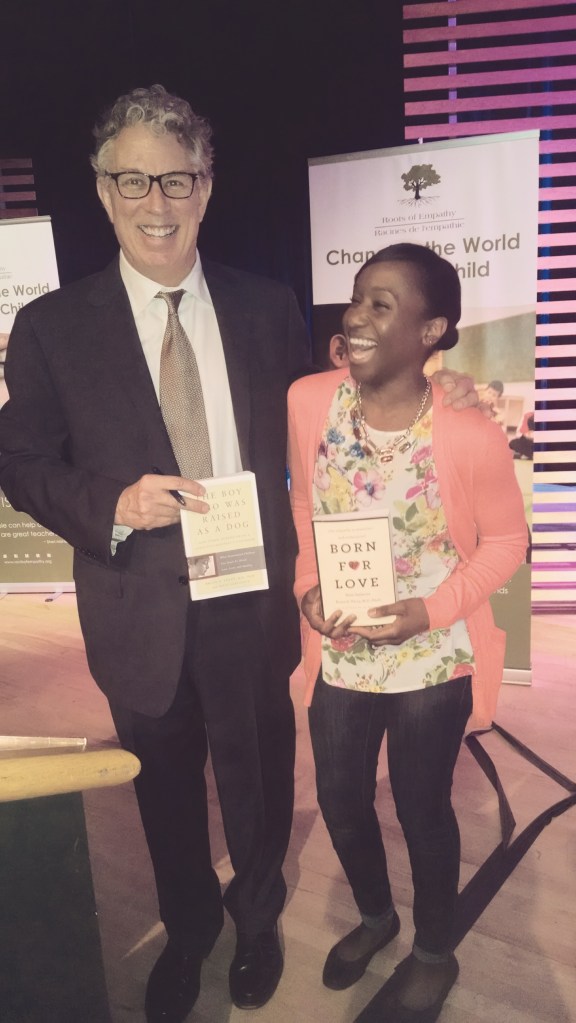
Meeting Dr. Bruce Perry on May 11, 2015 at the Roots of Empathy Research Symposium

Over the following two and a half years in the BCD program, not only would I be required to read this same book for one of my courses, but I’d also be invited by one of my professors to an event that Dr. Perry would be speaking at. Fast forward to May 11, 2015, where I’d be sitting alongside my peers at the Roots of Empathy Research Symposium in Toronto, Canada. That day, exactly 6 years ago today, I had the chance to meet one of my greatest inspirations in the field. Back in 2014 when I finally had a clearer idea of what I wanted to do with my life and what I was most passionate about, Dr. Perry further opened the doors to my interest in child and brain development, neuroscience, trauma and the importance of early childhood experiences. This brings me to the 2 reasons why I wanted to write and share this article with you:

  1. The Roots of Empathy will be hosting their 2021 Research Symposium on May 11th (today! what a coincidence) & 12th from 1:00-3:00 PM ET. It is virtual, free and open to the public. This event will bring together neuroscientists, psychiatrists, and experts on empathy like Dr. Richard Davidson, Dr. Dan Siegel, and of course, Dr. Bruce Perry.
  2. Dr. Bruce Perry and Oprah Winfrey are co-authors of a new book titled, What Happened to You? Conversations on Trauma, Resilience, and Healing, which was released on April 27th and is a #1 New York Times Bestseller.

While I won’t be able to attend the Roots of Empathy Research Symposium this year, I share it with the hopes that you might be able to attend and learn from it, as well as share it with others. I did, however, attend one of Perry and Winfrey’s virtual book tours and look forward to continuing reading What Happened to You? I can already see that it is making a significant impact on the world, and the ways that we view and understand early childhood experiences, brain science, trauma and healing. Have you gotten your copy yet? 📖


Interested in learning more about Roots of Empathy?


Interested in learning more about the What Happened to You?


WEBSITE DISCLAIMER

This website is provided only for informational purposes and not intended to be used to replace professional advice, treatment or professional care. Always speak to your physician, healthcare provider or pediatrician if you have concerns about your own health or the health of a child.

Just Playing

Early Childhood
little black girl in medical robe playing with toy stethoscope
Photo by Amina Filkins

By Anita Wadley

When I’m building in the block room, please don’t say I’m “Just Playing.”
For you see, I’m learning as I play about balances and shapes.
Who knows, I may be an architect some day.


When I’m getting all dressed up; setting the table, caring for the babies,
Don’t get the idea I’m “Just Playing.”
For, you see, I’m learning as I play;
I may be a mother or father some day.


When you see me sitting in a chair, reading to an imaginary audience.
Please don’t laugh and think I’m “Just Playing.”
For, you see, I’m learning as I play;
I may be a teacher someday.


When you see me combing the bushes for bugs,
Or packing my pockets with choice things I find; don’t pass it off as “Just Play.”
For, you see, I’m learning as I play;
I may be a scientist someday.


When you see me engrossed in a puzzle or some “plaything” at my school,
Please don’t feel the time is wasted.
For, you see, I’m learning as I play. I’m learning to solve problems and concentrate.
I may be in business some day.

girl in red dress playing a wooden blocks
Photo by cottonbro studio


When you see me cooking or tasting foods,
Please don’t think that because I enjoy it, it is “Just Play.”
I’m learning to follow directions and see differences.
I may be a cook someday.


When you see me learning to skip, hop, run and move my body;
Please don’t say I’m “Just Playing.”
For, you see, I’m learning as I play; I’m learning how my body works.
I may be a doctor, nurse or athlete someday.


When you asked me, what I’ve done at school today,
And I say “I just played”; please don’t misunderstand me.
For, you see, I’m learning as I play.
I’m learning to enjoy and be successful in my work;
I’m preparing for tomorrow.
Today, I am a child and my work is play.


Happy Early Childhood Educator Appreciation Day!

Becoming an ECE

Early Childhood

A lot of people think that we’re just here to play [and change diapers] they forget that we’re actually here to teach.”

– Preschool Teacher


One of the best decisions I ever made in my life was withdrawing from an undergraduate in Human Resources Management and going on to study Early Childhood Education (ECE). It was 8 years ago, September 2012, when my journey to become an ECE began and I walked into my first class at George Brown College. While it was an average class size of about 30 students, one of the first things I realized was that most of the class consisted of female students. This was something that had stuck with me throughout my academic career.

To give you an idea of what the Early Childhood Education program was like for me at the time…

Year 1, Semester 1: The first 7 weeks of the program began in class, where I was enrolled in about 7 courses. The following 7 weeks were spent out at a field placement where I would gain valuable, hands-on experience working and learning alongside my host-teacher. A host-teacher works at the placement site, guides you throughout your placement experience and is responsible for your evaluations. My first placement experience was working at a childcare centre with school-age children enrolled in an after-school program. Since placements generally consist of full 8-hour days, I worked in the preschool classrooms until my group of children arrived at the after-school program at the end of their school day.

An ice rink I created for the children at my preschool placement as an extension to the learning that was taking place.

Year 1, Semester 2: Once that placement was completed, it was back to class for another 7 weeks. My first year of the program would end with another placement which was working entirely with preschoolers. In between my 7 weeks of classes and 7 weeks at placement was one week off, commonly known as Reading Week. I’m grateful and lucky to have had that time to travel.

Year 2, Semester 3: My second year began the same way my first did. Seven weeks in class followed by 7 weeks in the field. By this point, I was at my third placement at a Lab school with infants. A Lab school has high expectations as it is operated in association with a college or university. I had never worked with infants prior to this placement but in the end, it was by far my most challenging and rewarding one.

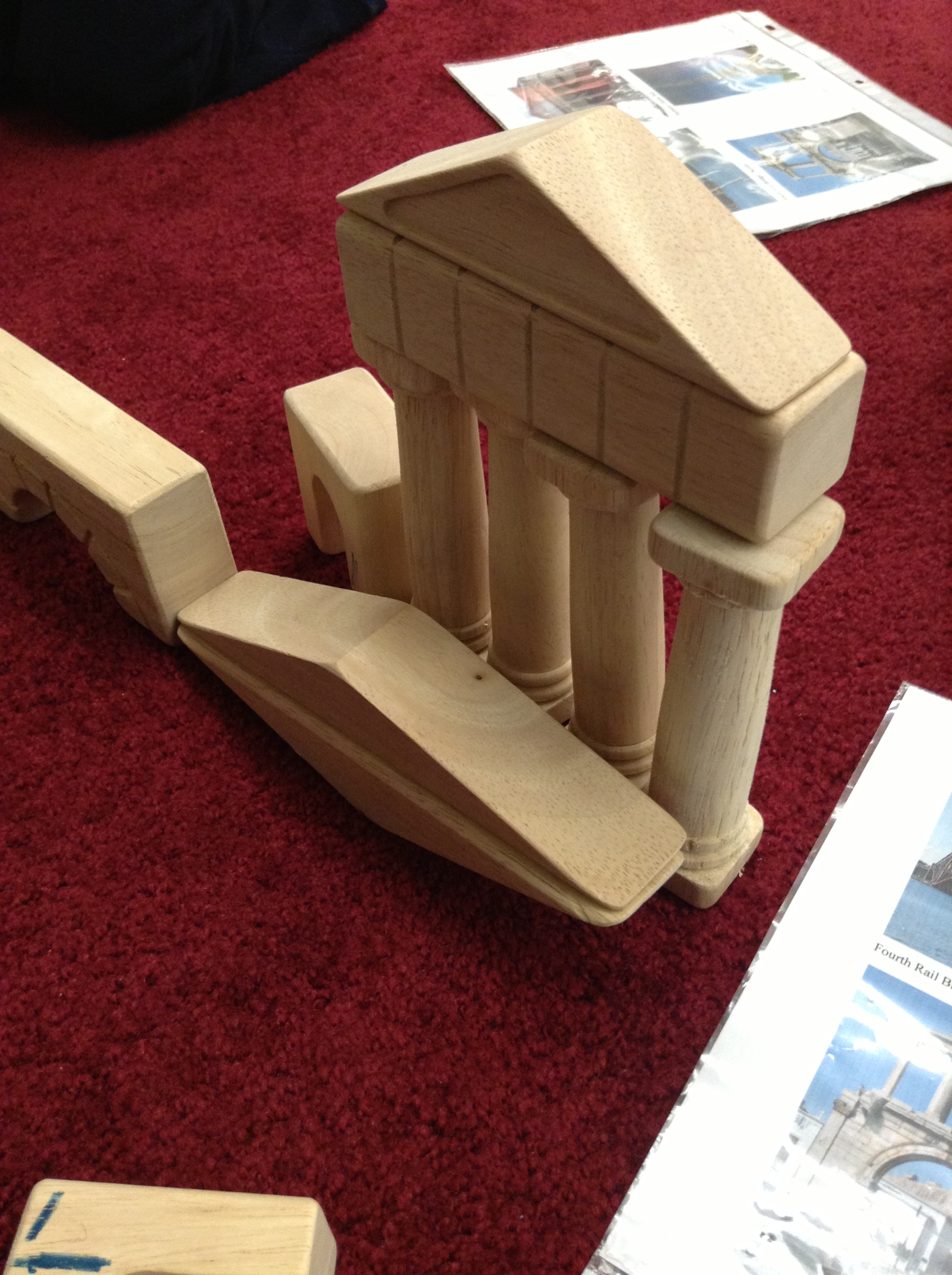
Students at my kindergarten placement re-created real life structures using wooden blocks.

Year 2, Semester 4: After my reading week, I returned to class for another 7 weeks and my final placement was working in a full-day kindergarten classroom within the Toronto Catholic District School Board. Once the program was completed, I registered with the College of Early Childhood Educators to be able to practice formally as a Registered Early Childhood Educator (RECE). Not too long after I graduated in April of 2014, I began working at a childcare centre with toddlers and preschoolers.

My academic career wouldn’t end there as I went on to complete 2.5 years of the Honours Bachelor of Child Development (BCD) degree program at Seneca College.

Having completed my ECE, I entered the fourth semester of the BCD degree program which is why I only had to complete 2.5 years of the 4-year program. The learning I gained in this program opened my eyes to a whole new depth of childhood and child development; from studying about children’s emotional well-being, to brain research and cognitive development, to screening and assessment tools and so much more. My whole understanding, approach and attitude towards the field was shaped drastically by everything I had learned in this program. I ended the BCD program having completed a research study titled, “Job Satisfaction Amongst Male ECE’s and Primary School Teachers”. Having realized how few males there were in both of the two programs I had been in and within the field itself, I had set out to uncover and learn the reasons why by interviewing men who were working as an early childhood educator or a primary school teacher about their level of job satisfaction in their role. Hats off to all the male educators who are working and making a difference in this profession!

My journey to becoming an Early Childhood Educator, followed by a Bachelors in Child Development was such a rewarding and enlightening experience for me, and I’m so grateful for all that I’ve learned from the children, families and educators at placements and from working in the field. For me, this is a journey that will never be over because I believe there is always room for growth and new experiences. This year, I obtained a certificate of completion for the Self-Reg in Early Childhood Development Program and I’m currently working towards completing a Self-Reg Facilitators course. I currently teach and inform educators about the importance of early childhood experiences, brain development, understanding self-regulation, stress and so much more. There really is no end to the learning of an educator as this is a field that is always changing. I’m so glad to have been able to make the choices in my life that allowed me to find the profession that I’m passionate about and proud to be apart of. Much love and appreciation goes out to my family who has always and continues to support me along my path.

Best of luck to all those studying to become Early Childhood Educators. May your passion for children and the profession grow stronger each day.


WEBSITE DISCLAIMER

This website is provided only for informational purposes and not intended to be used to replace professional advice, treatment or professional care. Always speak to your physician, healthcare provider or pediatrician if you have concerns about your own health or the health of a child.
Tips for Teachers Going Back to Work

Early Childhood, Health & Lifestyle, Self-Regulation

See my latest post: 5 Tips for Teachers to Start the School Year Grounded


I still can’t believe I’ve been out of the classroom for half a year. I say half a year because it’s actually really been that long. Since going on March Break, I have not been back to my school building since. In the last 6 months, I navigated and transitioned to online learning with preschoolers and then went straight into summer break. This has been an interesting year to say the least and I’m surprised at how quickly it has flown by, despite everything that has happened. I can’t help but say that I’m excited, (but mostly nervous) to go back to work, considering it’s been such an uncertain and scary time. That being said, I decided to put together a few tips for teachers who, like myself, will be heading back to the classroom (or maybe teaching online), very soon. Writing this and sharing these resources has given me some confidence, optimism and peace of mind about however this 2020-21 school year is meant to unfold, and my hope is that after reading this you will feel the same too.

self care isn t selfish signage
Photo by Madison Inouye

Find Your Calm – Explore Self-Reg and you will come to learn about Lending Your Calm. (I’m in the process of taking a second course with them.) However, I believe that in order for teachers (or anyone) to be able to lend their calm to their students and parents during this time, they first need to be able to find it. Stop and think to yourself, what exactly does calm feel like for me? What are some things that help me to feel calm? For me, it’s doing yoga, listening to music, working out, reading a book, and other times it’s meditating or taking a few deep breaths. Through these practices and activities, I’ve learned what calm feels like. When I’m not feeling it, I know exactly what helps me to get to that state. These past few months have been stressful on us all. This is why it’s so important to practice self-care and find what brings you calm so that you can bring that with you (as best as you can!) each day to work. We’ll surely need it!

alphabet class conceptual cube
Photo by Pixabay

Lend Your Calm – Once you discover what brings you calm and what that feels like, create that in your classroom environment. Calm begets calm. Our body is an energy source, allowing us to feel the vibrations from others. This is also known as limbic resonance or emotional contagion. Children are also able to feel and feed off of the energy from the adults in their lives and from their peers. For example, have you ever noticed how sometimes it only takes one student to change the energy of the entire class? When you feel calm, you can create that same feeling in your students, simply by just feeling it yourself. The beginning of the school year is naturally always stressful for teachers, parents and students. Apart from being calm yourself, think about the many ways you can create a calm and inviting classroom, overall school environment, or virtual learning experience. Whether it’s having less things mounted on the walls, playing calming music, integrating mindfulness-based activities (by engaging your student’s senses), or simply asking your student’s how they’re doing and feeling; when kids are not stressed and feel a sense of safety and calm, they are ready and able to learn at their best. 

woman applying hand sanitizer
Photo by Anna Shvets

Practice Consistency – The beginning of this school year will certainly be like no other. With new policies, guidelines and routines put into place, I imagine it will feel very different and new for us. If you’re physically back at school, it may take time to remember all the new rules and best practices such as washing or sanitizing your hands before and after removing your mask, but with consistency, you will naturally build up the habit of doing so. I’ve already started doing this when I go out so that it won’t all feel entirely new when I go back to work. It’s also important to build these practices with your students. It’ll all be new for them too and it’s much easier to build a routine and habit at the very start of a school year rather than later or halfway through it. Keep in mind that these procedures are in place to ensure the health, safety and well-being of both the school and external community. If you’re unsure about something regarding any of the new changes, don’t hesitate to ask and find out the right answers.

woman in white long sleeve shirt holding white smartphone
Photo by cottonbro

Stay Connected – Whether it’s with your family, friends or colleagues, stay connected with the people in your life. Maybe it’s catching up with a friend over the phone or sending an email to a fellow colleague to see how they’re doing. At the end of the day, we are social beings with a desire to connect, and simply having a chat with someone important in your life may be all it takes to turn your own or someone else’s day around. Lean on your support system when needed and make opportunities for connection with others a part of your daily routine. You’ll truly notice the difference it makes in your attitude, the way you feel, the way you go about each day, and it’s also a great way to boost your immune system!

anonymous ethnic tutor helping little multiracial students with task in classroom
Photo by Katerina Holmes

Take It Slow – Regardless if you’ve been teaching for 20 years or are a new teacher starting your first year, this school year will be new for all of us. New students, families, routines, schedules, procedures, guidelines, expectations, and much more. If you’re finding that you’re already beginning to feel overwhelmed, go back to Finding Your Calm. Notice what you’re feeling and find what feels good and what brings you a sense of calm. One thing I always practice is mindfulness and living in the present moment. I can’t worry and be anxious about the first day of school because I don’t know what to expect. I’m only in control of the here and now so that’s what I choose to focus on. As each day comes and goes, take it slow, ask the questions you need answers to, build relationships and connections, and most importantly, be kind and do your best. And remember, you are the expert in pedagogy and curriculum. Be confident in your abilities, strengths and everything you already know. We got this!

Got more tips for teachers going back to school? Share them in the comments below!


WEBSITE DISCLAIMER

This website is provided only for informational purposes and not intended to be used to replace professional advice, treatment or professional care. Always speak to your physician, healthcare provider or pediatrician if you have concerns about your own health or the health of a child.