“No matter what you eat, how much you exercise, how skinny or young or wise you are, none of it matters if you’re not breathing properly. There is nothing more essential to our health and well-being than breathing: take air in, let it out, repeat 25,000 times a day. Yet, as a species, humans have lost the ability to breathe correctly, with grave consequences.”
– James Nestor, Breath: The New Science of a Lost Art
How to Breathe! To Activate the Calm Response in Your Body is a video presentation by Melissa Holland Mansika. Melissa is a stay-at-home mom, homeschool teacher and career and life transition specialist from Boulder, Colorado. She has a background in teaching graduate psychology students career counselling, life transitions and positive psychology. It is a pleasure to learn from and alongside her as one of my peers in the Self-Reg Facilitator’s Program course!
As a result of her curiosity on the breath and breathing, she created and shared this video presentation about a way of breathing that can activate the calm response in the body. Upon request, after watching her presentation, Melissa kindly gave me permission to share it. In this video, she shares traps and tips of breathing, the anatomy of the breath, and the difference between nasal and mouth breathing. Thank you, Melissa, for expanding my understanding on the breath and breathing, and for allowing your knowledge on this topic to be shared with others!
“Taking some time to learn about the complexity of the breath in the human body, can result in greatly reduced hidden stressors.”
– Melissa Holland Mansika
How to Breathe! To Activate the Calm Response in Your Body by Melissa Holland Mansika
This website is provided only for informational purposes and not intended to be used to replace professional advice, treatment or professional care. Always speak to your physician, healthcare provider or pediatrician if you have concerns about your own health or the health of a child.
I decided to share this discussion post entry I wrote for the online Self-Reg course I’m currently taking. I imagine a lot of people who are either working or studying from home can relate to sitting in front of a computer screen for long hours of their day or having to start an online course in the evening. In this entry, I share a short reflection of my own experience with noticing a shift in my energy and tension while working towards completing an online course late in the day.
Photo by Peter Olexa
I usually dedicate my weekends to completing my online course modules because I already know that during the week, by the end of a long day at work, that I have very little energy to stay focused on videos and readings. Although I had a busy day yesterday, I knew I wanted to at least begin the module before the end of the night. By the time I finally arrived home and settled in to begin watching the first video of the module, it was already evening. This was a lot later than I’d normally start a module on a weekend. Generally, on a Saturday morning, I’d wake up, workout or do yoga, and then begin a module. So, I already knew I was starting this at a much later time in the day than I normally would have; and to be honest, I wasn’t sure what to expect in terms of how my energy level would sustain throughout the learning. As I began watching the presentation, I noticed my energy level was fairly high. I was comfortable, focused and taking notes. However, I did notice that 40 minutes into the video that my energy level was starting to deplete. I was aware that I had started to feel a little antsy in my chair and noticed my attention start to shift. Although I played the video out until the end, I know that I will need to go back and re-watch the ending of it because I have little recollection of what was mentioned.
Being able to notice the tension I was beginning to experience and that my attention had shifted allowed me to recognize that I had not retained the information from the entire video, and also that there were other stressors that were impacting my ability to remain focused. Having an awareness about how stress and tension impacts my energy and focus has continuously allowed me not to become frustrated or overwhelmed when my mind and body is telling me that I either need to take a break, pause or stop something all together. Because my energy was depleted by the end of the video and it was already so late in the night, I decided to continue the rest of the module today.
Photo by Self-Reg
Building an awareness of your stress, energy and tension is a process that takes time and getting to know yourself much more deeply. Start by noticing when you may be experiencing a shift in your energy (e.g., unable to focus or feeling sleepy) and what things help you to restore. This could be something you’ve tried in the past or as simple as having a drink of water or a snack, taking a break to stretch your legs, or going outside for some fresh air or a walk. The following snippet from a Self-Reg article can help you better understand how your body sends you signals of when your alertness may be shifting:
“Back in the 1960s, the so-called Father of modern Sleep Research, Nathaniel Kleitman, discovered that the brain operates on a circadian basic rest-activity cycle (BRAC), in which we move from higher to lower alertness every 90 minutes. That is, we go through this cycle as much when we are awake as when we are asleep (i.e., the REM sleep-cycle). The brain sends signals of when we are entering this less reactive state during the awake-phase: e.g., we become restless, drowsy, or lose focus. But in our modern fast-paced world we tend to either ignore or override these signals (e.g., with adrenaline, caffeine, sugar, or our smartphones), propelling us towards a chronic low-energy/high-tension state. So the goal of a mindfulness practice like yoga is not only to build in the much-needed restorative breaks, but to become more aware of and heedful of these signals.” (Shanker, 2017).
Know that each day your stress, energy and tension will vary, and so too might the strategies or practices that help you to rebalance and restore. Take time to explore and embrace the ongoing process of building your own stress awareness, and listening to and understanding your brain-body signals. Despite all that I’ve come to learn about myself, I have accepted that this is a lifelong process; one which I owe to discovering, learning and practicing Self-Reg.
This website is provided only for informational purposes and not intended to be used to replace professional advice, treatment or professional care. Always speak to your physician, healthcare provider or pediatrician if you have concerns about your own health or the health of a child.
I still can’t believe I’ve been out of the classroom for half a year. I say half a year because it’s actually really been that long. Since going on March Break, I have not been back to my school building since. In the last 6 months, I navigated and transitioned to online learning with preschoolers and then went straight into summer break. This has been an interesting year to say the least and I’m surprised at how quickly it has flown by, despite everything that has happened. I can’t help but say that I’m excited, (but mostly nervous) to go back to work, considering it’s been such an uncertain and scary time. That being said, I decided to put together a few tips for teachers who, like myself, will be heading back to the classroom (or maybe teaching online), very soon. Writing this and sharing these resources has given me some confidence, optimism and peace of mind about however this 2020-21 school year is meant to unfold, and my hope is that after reading this you will feel the same too.
Photo by Madison Inouye
Find Your Calm – Explore Self-Reg and you will come to learn about Lending Your Calm. (I’m in the process of taking a second course with them.) However, I believe that in order for teachers (or anyone) to be able to lend their calm to their students and parents during this time, they first need to be able to find it. Stop and think to yourself, what exactly does calm feel like for me? What are some things that help me to feel calm? For me, it’s doing yoga, listening to music, working out, reading a book, and other times it’s meditating or taking a few deep breaths. Through these practices and activities, I’ve learned what calm feels like. When I’m not feeling it, I know exactly what helps me to get to that state. These past few months have been stressful on us all. This is why it’s so important to practice self-care and find what brings you calm so that you can bring that with you (as best as you can!) each day to work. We’ll surely need it!
Lend Your Calm – Once you discover what brings you calm and what that feels like, create that in your classroom environment. Calm begets calm. Our body is an energy source, allowing us to feel the vibrations from others. This is also known as limbic resonance or emotional contagion. Children are also able to feel and feed off of the energy from the adults in their lives and from their peers. For example, have you ever noticed how sometimes it only takes one student to change the energy of the entire class? When you feel calm, you can create that same feeling in your students, simply by just feeling it yourself. The beginning of the school year is naturally always stressful for teachers, parents and students. Apart from being calm yourself, think about the many ways you can create a calm and inviting classroom, overall school environment, or virtual learning experience. Whether it’s having less things mounted on the walls, playing calming music, integrating mindfulness-based activities (by engaging your student’s senses), or simply asking your student’s how they’re doing and feeling; when kids are not stressed and feel a sense of safety and calm, they are ready and able to learn at their best.
Practice Consistency– The beginning of this school year will certainly be like no other. With new policies, guidelines and routines put into place, I imagine it will feel very different and new for us. If you’re physically back at school, it may take time to remember all the new rules and best practices such as washing or sanitizing your hands before and after removing your mask, but with consistency, you will naturally build up the habit of doing so. I’ve already started doing this when I go out so that it won’t all feel entirely new when I go back to work. It’s also important to build these practices with your students. It’ll all be new for them too and it’s much easier to build a routine and habit at the very start of a school year rather than later or halfway through it. Keep in mind that these procedures are in place to ensure the health, safety and well-being of both the school and external community. If you’re unsure about something regarding any of the new changes, don’t hesitate to ask and find out the right answers.
Stay Connected– Whether it’s with your family, friends or colleagues, stay connected with the people in your life. Maybe it’s catching up with a friend over the phone or sending an email to a fellow colleague to see how they’re doing. At the end of the day, we are social beings with a desire to connect, and simply having a chat with someone important in your life may be all it takes to turn your own or someone else’s day around. Lean on your support system when needed and make opportunities for connection with others a part of your daily routine. You’ll truly notice the difference it makes in your attitude, the way you feel, the way you go about each day, and it’s also a great way to boost your immune system!
Take It Slow – Regardless if you’ve been teaching for 20 years or are a new teacher starting your first year, this school year will be new for all of us. New students, families, routines, schedules, procedures, guidelines, expectations, and much more. If you’re finding that you’re already beginning to feel overwhelmed, go back to Finding Your Calm. Notice what you’re feeling andfind what feels good and what brings you a sense of calm. One thing I always practice is mindfulness and living in the present moment. I can’t worry and be anxious about the first day of school because I don’t know what to expect. I’m only in control of the here and now so that’s what I choose to focus on. As each day comes and goes, take it slow, ask the questions you need answers to, build relationships and connections, and most importantly, be kind and do your best. And remember, you are the expert in pedagogy and curriculum. Be confident in your abilities, strengths and everything you already know. We got this!
Got more tips for teachers going back to school? Share them in the comments below!
WEBSITE DISCLAIMER
This website is provided only for informational purposes and not intended to be used to replace professional advice, treatment or professional care. Always speak to your physician, healthcare provider or pediatrician if you have concerns about your own health or the health of a child.
I’m grateful to share with you this inspiring “everything self-care” article, written by my best friend who I’ve had the pleasure of knowing for many years. If you haven’t begun your own self-care routine and are thinking about getting started, in this article, Kaitlin shares with you how she came to discover self-care, a complete insight into her own routine, along with suggestions and tips to get started. Thank you, Kaitlin, for taking the time to share with others your own experience on such an important topic!
Written by Kaitlin Findlay
“Honour yourself to love others.” – Paul Colaianni
Self-care is not selfish. It is a practice of self-love, respect, and appreciation for ourselves so that we can love, respect, and appreciate others. Before I began my self-love journey in March of this year, my typical morning during the week would look like this: wake up at the latest time possible, hop out of bed to get ready, pack my lunch, and off to work I went. My typical morning routine on the weekends would look like this: sleep in, grab my phone to scroll on social media for at least an hour, and then slowly get out of bed to get ready for the day. I realize now, looking back, that both routines were toxic to my mental health as I focused my attention and awareness on other people, and as a result, neglected myself.
I have found that creating and practicing self-care every morning to start my day has given me two things:
Motivation: My morning self-care routine has motivated me to be the best person I can be everyday. When I take the time in the morning to reflect on my feelings and thoughts and to praise myself for the beautiful human I am, it literally hypes up my soul to start my day off with positive energy. This allows me to regulate my emotions and thoughts for the remainder of the day so that I can have the best day possible.
Self-esteem and Self-confidence: The second thing my morning self-care routine has given me is self-esteem and self-confidence. Before this, I lacked these two things as I would self-sabotage myself throughout most of my day. Now, loving myself for the first few hours of my day has allowed me to accept that I am beautiful, worthy and therefore, I view myself differently now than before and it feels incredible.
So, what does my morning self-care routine look like?
I have tried many different things and have perfected what I do now to suit what lifts me up every morning. My routine takes me around three hours to do, but this is simply because I have the time to do it for that long.
My Morning Self-Care Routine
Drink a litre of water Filling my body with water at the very beginning of the day helps me to rehydrate and refresh from my beauty sleep.
Listen to a podcast I lie in bed while I listen to a podcast to help wake me up. I usually pick podcasts that will strengthen my self-love as this is something I am currently working on.
Read a daily affirmation Affirmations are powerful as they help bring truth to light. They allow us to appreciate ourselves for the beautiful humans we all are.
Engage in a guided meditation This is an art that I am still practicing. My end goal is to be able to meditate on my own, but for now, I do guided meditations to help clear my thoughts and emotions.
Write in a journal I have a love for journalism as I’ve been doing it since I was 12. I have kept all of my journals and when I look back, I used to write everyday and write every small detail! In university, it started to become less frequent and I tended to only write when I was at a low. Once I started working with my life coach (shoutout to Hillary Flinn!) she suggested I journal when I was happy too and told me to get a writing-prompt journal for the days I didn’t know what to write about. I have been journaling everyday since! The art of journalism helps me to organize and clear my thoughts and emotions. It’s one thing to always be reflecting in your brain, but another to write those reflections down.
Kick my own butt with some exercise I have recognized the benefits of working out at the start of my day rather than anytime afterwards because it gives me the energy to continue the rest of my day on a high. My current workouts entail cardio (running) and then weight training (a different muscle each day).
Here are some other suggestions of what you can add to your own morning self-care ritual:
Stretch
Make the bed
Clean room
Take an Epsom salt bath
Yoga
Morning devotion
Pray
Singing bowl
Skin care routine
Shower
Listen to music
Go outside
Read
Do a puzzle
Write down daily achievable goals
Talk to self in the mirror
Visualization of where you want to be
Tips to get you started:
Start off small If you’re just beginning your morning self-care routine journey, it can feel intimidating and overwhelming. I suggest you start off small! Set aside five-to-ten minutes of your time for self-care and do something simple. Become comfortable with that small routine and then you will naturally want to add to it.
Be consistent There were times in the beginning of my journey that I felt like giving up. I couldn’t stay mentally focused on the tasks and I felt like I wasn’t getting better. The famous saying, “practice makes perfect” stays true to a morning self-care routine (although perfect looks different for everyone). I’m only feeling good about it now, after six months of practicing, with way more room for growth. With time comes progress and I promise it gets easier.
Say no to your phone Do you wake up and look at your phone right away? Scroll through social media and check who messaged you? I used to! It set me back not only time wise, but mentally too. Waking up and immediately looking at my phone affected my self-esteem and self-worth as I was comparing myself to others, right at the beginning of the day. I have made it a rule to not look at anything on my phone (other than my podcasts and meditation) until I have completed my self-care routine. It allows me to focus on myself so that I have enough energy to engage with others.
I can’t even begin to explain how rewarding waking up every morning to work on myself has felt. Although Covid-19 has brought us a lot of sorrow, I appreciate the time it has given me to work on myself, as I would not be where I am right now. It takes a lot of self-discipline, time, and effort, so I am thankful this pandemic has given me the opportunity to fully engage in this process. Now that I am more comfortable with my routine, I will be able to modify it for when I do have to return back to work as I will not have as much time. I now understand that if you put yourself first and if you make your happiness a priority, then you will naturally want to make the effort to practice self-care, no matter how much earlier you have to wake up. You will want to practice self-care because you love and care for yourself and your well-being. So, ask yourself, how much do you love yourself?
This website is provided only for informational purposes and not intended to be used to replace professional advice, treatment or professional care. Always speak to your physician, healthcare provider or pediatrician if you have concerns about your own health or the health of a child.
I’d first like to respectfully acknowledge the varying impacts we’ve each experienced during this global pandemic. While there is no one way to deal with a life-altering event such as this, and many others that are happening around the world, my hopes by sharing this article of my own experience (and this website) is to bring to light the knowledge, information and resources that have supported me in better understanding the ways we as humans cope with and experience the flow of life.
I never for a second thought I’d be writing about the days I struggled through during lockdown, with all that I know about the human brain, body, its response to stress and stress management. But, here I am and here you are reading this.
A little over a year ago I came across The MEHRIT Centre, an organization focussed on grounding learning and living in self-regulation. I’m currently in the process of completing a second course from them and have shared some of their resources throughout the self-regulation sections of this website. One of their many useful resources is the Thayer-Matrix. I discovered the Thayer-Matrix last year, but it wasn’t until recently when I revisited its connection to motivation.
Being in Lockdown
Around mid-May, as I was nearing the end of the school year, there were days when my motivation was so low that I found myself mentally checking out from online learning. I had missed being in the classroom and with my students. Prior to school closures in March, I was spending many hours at school each day, so working from home was quite the adjustment for me. As the school year progressed through online learning, I struggled transitioning into a new routine and there were days when I didn’t even feel like getting out of bed.
Now let me explain what the Thayer-Matrix is.
The Thayer-Matrix
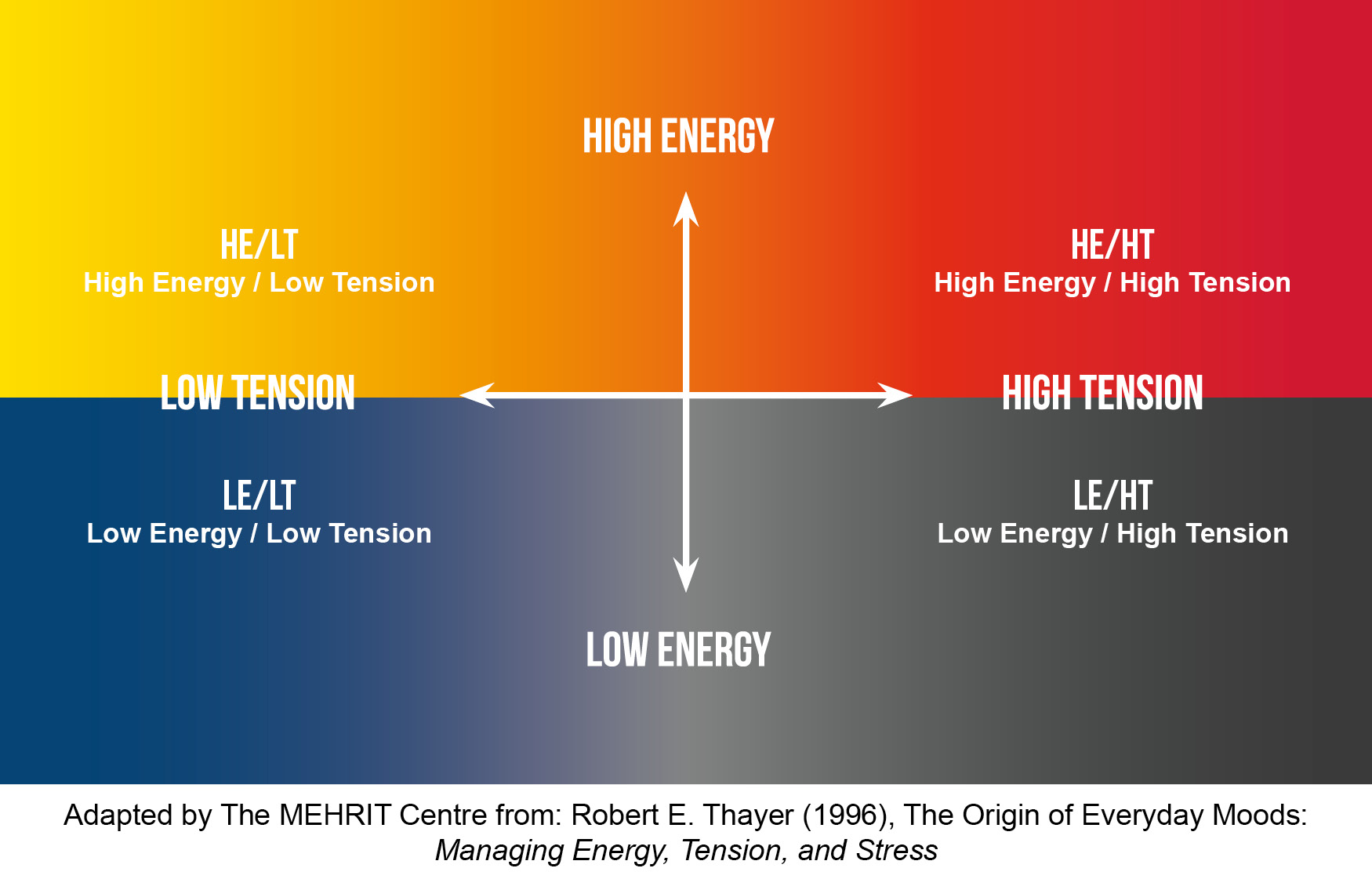
The Thayer-Matrix was created by Robert E. Thayer, an American psychologist known for his work on the connection between mood, energy, tension and stress which is reflected in his energy/tension (Thayer-Matrix) model (see image below).
(The information and examples provided below are entirely my interpretation of how I’ve applied this model to my own experience, what I’ve learned and how I understand it)
High-Energy/Low-Tension (HE/LT)
When our energy is high and tension (i.e., stress) is low, we are in a High-Energy/Low-Tension state. In this state we tend to feel:
Well-rested and energized
Calm and relaxed
Ready to start the day at hand
An example of this state would be waking up on a day-off, or while on vacation, feeling well-rested (high-energy) and ready to ease into an open-ended kind of day (low-tension).
High-Energy/High-Tension (HE/HT)
When our energy and tension are both high, we are in a High-Energy/High-Tension state. In this state we tend to feel:
Motivated with complete concentration and focus
Able to remain at a task for longer and with the most effort
Positive and productive
An example of this state would be waking up feeling well-rested (high-energy) and motivated to tackle a busy day ahead (high-tension).
Low-Energy/Low-Tension (LE/LT)
When our energy and tension are both low, we are in a Low-Energy/Low-Tension state. In this state we tend to feel:
Tired, especially towards the end of a long and busy day
Ready to wind down and relax
Prepared to sleep and replenish our energy
An example of this state would be arriving home, tired from a busy and productive day (low-energy) and ready to ease into the night with a hot cup of tea (low-tension).
Low-Energy/High-Tension (LE/HT)
When our energy is low and tension is high, we are in a Low-Energy/High-Tension state. In this state we tend to feel:
Drained and exhausted
The least motivated (i.e., listless)
Stressed, possibly with lots still to do or lots on your mind
This was how I was feeling on my lowest day. Super drained with little to no motivation (low-energy), but with a lot on my plate (high-tension). These were the days where I struggled with getting out of bed, starting my workday or working towards getting things done.
Moving Through the Thayer-Matrix
Ideally, we should be moving through each of these states and not get stuck in any one of them for a long period of time. If stuck in a HE/HT state, this is likely being sustained through stimulators such as caffeine or energy boosters, and the natural production of adrenaline that works to keep you at a high-energy state to deal with high-tension. However, high-tension naturally drains our energy reserves. When we aren’t restoring enough through natural and essential sources of energy, such as through a restful sleep, eating healthy foods, and engaging in sustainable routines and practices (such as going for a walk outside), we may tend to seek alternative (and often maladaptive) ways to do so, especially at times when we really need to, or simply to cope. From what I learned in my course, being chronically stuck in a LE/HT state can lead to mood disorders. Having a support system and stress awareness and management practices are essential. While staying in a HE/LT state would be nice, that is just not how life flows. Stressors from all around and inside us is what keeps us going, and when effectively managed, thriving. Lastly, we also don’t want to get stuck in a LE/LT state, becoming passive and listless. Humans (as well as animals) have a seeking system that exists in the brain and drives us to meet a need, craving, goal, desire and ultimately, to survive1.
Now, here’s how I was able to get through some of my lowest days in lockdown.
Moving from a LE/HT to a HE/HT State
Leading an online learning session with my students
First to begin, I needed to be aware of when I was in a low-energy/high-tension (LE/HT) state and what that felt like for me. I knew I had low energy because I felt physically, emotionally and mentally drained, listless, a lack of motivation or desire to do anything. At the beginning of lockdown, a telltale sign of this was when I started losing track of what day it was. I woke up one morning thinking it was Sunday, when in fact, it was Thursday. I eventually realized this was happening because I wasn’t getting outside and in the sun. The sun sends signals/cues to regulate our circadian rhythm which is our internal sleep-wake 24-hour body clock. It also gives us energy, makes us feel good and increases serotonin, a neurotransmitter in our body that is responsible for mood, well-being and feelings of happiness. BINGO! So, I knew I needed to get outside more, or as much as I possibly could (considering the circumstances). In addition, the sun is our ultimate source of energy and if we could eat it, we probably would! Instead, we must settle for eating the foods that absorb the sun’s energy for us (to learn more, google: “high vibration foods”). As I think back to it now, that seems so obvious, right? But at that point in time, it actually wasn’t as clear cut, and I guess that came with adjusting and transitioning to being at home, rather than at school for almost 10 hours of the day. While I was getting enough sleep, I wasn’t waking up feeling energized and refreshed (I highly recommend this podcast episode: How to Sleep Well). Having been physically active my whole life, my body wasn’t used to not moving around as much. Because I wasn’t moving around as much as I had been (I work with toddlers), I wasn’t exerting as much energy, nor was able to reach a high-energy state. As a result, I knew I needed to resume more physical activity which had always been an energy booster for me. I recognized I was in a high-tension state because of the stressors that were affecting me. Not being able to leave the house as much, see my friends or go out. The list can go on. I was looking at a screen way more and for longer periods at a time for online learning, meetings, program planning, corresponding with colleagues, attending webinars, social media, etc. Because my eyes were feeling strained near the end of the day, I knew I needed to be as mindful as possible of my screen time. I couldn’t change the fact that I still needed to work, be online and in front of a screen, but what I could change was my energy state to match it. Therefore, once I started getting outside (while taking the necessary precautions), working out at home and managing my screen time better, I was able to move myself from a low-energy to a high-energy state in order to meet the demands of my high-tension work week.
Moving from a HE/HT to a LE/LT State
As soon as I was able to balance my energy and tension to a HE/HT state, I began feeling motivated, greater concentration, was able to remain working for longer and with more effort, and overall, I felt good, productive and accomplished. By the end of my workday, my meetings and online learning were done for the day. This is where I transitioned from the high-tension state I was in throughout the day into a low-tension state. By the end of a busy day, our body naturally transitions into a low-energy state, depending on the amount of energy that was exerted, and the tension experienced throughout the day. When the things that are a source of high-tension (i.e., stressors) in your life are recognized, managed and reduced, you can begin to move into a low-tension state. Although this may not always be the case, ideally, LE/LT is where you want to be at the end of the day and it’s all a matter of finding what works for you to maneuver your way in, out and through these states, while knowing your stress load capacity. Some people can cope with and under more stress than others. It’s important to note that children experience and transition through these states as well, but their capacity to deal with stress is much lower than adults. Therefore, helping them navigate through these states is so important.
Strategies for Moving through Energy & Tension States
Become aware of what your mind and body feel like in each state of energy and tension. For example:
High-Energy:
Energized
Feeling well-rested and healthy
Having positive feelings (e.g., when laughing or talking with others)
Feeling motivated
Having complete concentration and focus
High-Tension:
Having lots to do
A busy day ahead (e.g., heavy workload, working on tasks)
Feeling stressed or overwhelmed (see: Stress & Stressors to identify the source of your tension)
Low-Energy:
Feeling tired and exhausted
Lack of motivation
Feeling sick (when we are sick, our body naturally produces chemicals that make us sleepy)
Drained from high-tension
Low-Tension:
Feeling calm, relaxed, at ease
Having stress management strategies in place (e.g., meditation, yoga, deep breathing, prayer)
Relying on a positive support system (family, friends, community and/or professionals)
Maintaining effective routines and practices
Know what personal strategies work to move you to the state you want or need to be in:
Getting into a High-Energy state:
Getting good sleep: amount, quality, timing, state of mind (these are mentioned in the podcast)
Eating healthy and nutritious (high vibration) foods and drinking lots of water
We usually don’t choose to enter this state. Our body naturally enters high-tension states because of the stressors that exist around us. Stressors affect each of us differently so it’s important to know which ones have the most impact on you. For example, feeling too hot, feeling sick, excessive screen time, watching the news, changes in routine (see: Stress & Stressors).
Entering a Low-Energy state:
Again, we don’t choose to enter this state. Our body naturally enters low-energy states as we exert energy and experience stress, which is what drains our energy reserve throughout our day. We can settle into this state at the end of a long day with an evening routine that might consist of practices that lower tension such as reading a book, drinking a cup of tea, prayer, expressing gratitude in writing, meditating, taking a bath or doing bedtime yoga.
Getting into a Low-Tension state:
This requires recognizing your stressors, managing and reducing them. Engaging in self-care and low-tension practices is also important here. This isn’t always easy, but with time and support, you can develop these practices and habits. For example, I know that too much time in front of a screen strains my eyes so I balance and manage my screen time by taking breaks from it, adjusting display settings, and shutting my devices down at the end of the day and long before bed.
Build and maintain a routine:
Humans like routine; however, the pandemic has disrupted what our normal routines used to be. Our schedules are different and as a result we may be doing less (or more) than we had been before. Develop a morning and an evening routine to move yourself through the energy and tension states you want or need to be in to be productive, make the most, and meet the demands of your day.
Engage in movement and physical activity:
Our bodies are designed to recover from energy exertion through our parasympathetic system. When we don’t move, our body doesn’t know what to do with the extra energy and this can impact sleep. Go walking, running, bike riding, do gardening, spend some time out in the sun, sweat and burn energy whenever and however you can.
Don’t be so hard on yourself:
We are all human and we do the best we can in each moment. Remember that the human body consists of a nervous system that responds to stress. What’s most important is understanding this and how we manage it. A great place to start is by learning about self-regulation (see: What is Self-Regulation?) and reframe your understanding about how your body naturally responds when under various types of stress. You can then start to identify what are sources of high-tension (stressors) for you and develop personal stress management strategies that help you navigate through energy and tension states. Realize when things are beyond your control and when needed, seek professional support and always connect with people you can talk to and trust.
We are in this together.
I hope this article was helpful in some way or another.
Wishing you the very best.
If you enjoyed reading this article, subscribe (for free) to receive the next one straight to your inbox!
Reference: 1Shanker, Stuart. Reframed: Self-Reg for a Just Society. University of Toronto Press, 2020.
This website is provided only for informational purposes and not intended to be used to replace professional advice, treatment or professional care. Always speak to your physician, healthcare provider or pediatrician if you have concerns about your own health or the health of a child.
As part of my Self-Reg Facilitator’s Program course with The MEHRIT Centre, we are always tasked with responding to a series of discussion questions. For last week’s module, we were asked to reflect and respond to one of two quotes. I decided to share the quote and my short reflection on it.
Reading this quote by Susan Hopkins brings to mind what Dr. Stuart Shanker said about the womb not being a stress-free environment, but rather, a stress-reduced environment. Self-regulation is how we manage stress. Even before we are born into this world full of different stressors, we have already encountered and been exposed to a certain degree of stress (low to high) from and through our mother, while in the womb. This can be due to her adjusting to the changes that come with pregnancy (hormonal, emotional, mood, daily routines), possible existing health challenges, environmental stressors, just to list a few. The fetal brain and spinal cord (central nervous system) is the first to develop during fetal development at about week 3 until full term (see: Sensitive Periods of a Baby’s Development). Our nervous system is what’s responsible for our stress response. So even before we are born, that system has already been actively developing and engaged in the womb, and if there are no complications, should be fully developed by the time we are born. Babies are ready for self-regulation from the time their central nervous system is beginning to develop. A fetus in the womb depends on its mother’s ability to self-regulate (manage the stress and changes that come with life and pregnancy) before they are born. As Stuart says in Reframed: Self-Reg for a Just Society, they are “transitioning from one type of womb to another, an ‘external womb'”. Since babies can’t yet self-regulate on their own, once they enter the “external womb” (the world), they depend on the adults in their lives to help them to do so.
“In the last trimester, fetuses are capable of simple forms of learning, like habituating (decreasing their startle response) to a repeated auditory stimulus, such as a loud clap just outside the mother’s abdomen. Late-term fetuses also seem to learn about the sensory qualities of the womb, since several studies have shown that newborn babies respond to familiar odors (such as their own amniotic fluid) and sounds (such as a maternal heartbeat or their own mother’s voice). In spite of these rather sophisticated abilities, babies enter the world with a still-primitive cerebral cortex, and it is the gradual maturation of this complex part of the brain that explains much of their emotional and cognitive maturation in the first few years of life.”
Children are always ready for self-regulation. There is only and always now.
WEBSITE DISCLAIMER
This website is provided only for informational purposes and not intended to be used to replace professional advice, treatment or professional care. Always speak to your physician, healthcare provider or pediatrician if you have concerns about your own health or the health of a child.
Stress: anything that requires our internal system to burn energy in order to maintain some sort of internal balance.
Stressors: an event or experience that triggers stress.
Dr. Stuart Shanker identifies stressors across 5 domains:
While the examples of stressors provided from the links below have been tailored to children and their learning, many of them are stressors that adults can relate to having as well. (Visit: Stressors in the 5 Domains of Self-Reg for a list of more examples to the ones provided below)
The Biological Domain
Biological: Internal or external stressors that affect our physiological system
e.g., hunger, feeling sick, a loud noise, screen time
Emotion: Stressors related to strong emotions, both positive and negative
e.g., fears, change of routine, excitement, grief/loss
Cognitive: Stressors related to difficulty processing certain information
e.g., time pressure, learning something new, boredom, multi-tasking
Social: Social stressors, related to social cues and the behaviour of self and others
e.g., social media, peer pressure, confrontation, meeting someone new
Prosocial: Stressors related to difficulty coping with the stress of others
e.g., empathy/sympathy, a sad friend, watching the news, injustice
The 3 Types of Stress
Positive: A stressor that is moderate and short-lived, resulting in brief increases in heart rate and blood pressure. This kind of stress is normal, essential to healthy development and is buffered by protective factors such as a positive support system made up of family, friends and/or healthy lifestyle practices.
e.g., The first day on the job/of school, meeting new people, dealing with frustration, giving a presentation
Tolerable: A more sereve stressor that could have long-term consequences but is buffered by protective factors such as a positive support system and healthy lifestyle practices.
e.g., Dealing with the illness or loss of a loved one, recovering from an injury, adjusting to a global pandemic
Toxic: A threatening and adverse stressor that results in frequent and prolonged activation of the stress response system. These types of stressors lack the presence of protective factors such as a support system.
e.g., Experiencing abuse or exposure to violence, extreme poverty, turbulent living situations
These types of stress are especially important to be mindful of for young children and teens. This is because their brain’s are in the process of development and don’t fully develop until their mid-20s (particularly the prefrontal cortex – the thinking part of the brain), and because their health and well-being are dependant on protective factors such as the care and support of the adults in their lives. These adults are also the ones that help them to self-regulate and develop the healthy lifestyle practices that they will carry with them throughout adulthood.
Dealing with Stress
As with any type of stress (mainly positive and tolerable), having protective factors such as a buffer (caring and supporting people in your life to help you manage the stress and recover from it) is one of the greatest ways to deal with stress. When there is a lack of a buffer, defense mechanisms or poor and harmful coping strategies may ensue.
A young child with great stress and no buffer could experience impairments to brain development (detrimental at a time when their brain is developing; see: Brain Development in the Early Years). As a result, this child may have difficultly with:
Self-regulation: managing stress and different stressors
Engaging in social interactions
Forming relationships with others
Identifying, expressing and managing their emotions
They may be easily triggered and reactive or subdued and withdraw (fight, fight, freeze responses)
Developing healthy coping strategies; potentially resulting in maladaptive behaviours
Long-Term Effects of Stress on the Body
Since our nervous system plays a role in our stress response, too much stress over a long period of time is harmful to our brain and body. Prolonged activation of our body’s stress response system can:
How Stress Affects Your Body
Impact the cardiovascular system, especially if the body is constantly pumping oxygen to the heart and releasing adrenaline when under a lot of stress
Elevate blood pressure, which can impact the heart
Affect metabolism since glucose pumps into the bloodstream giving you a burst of energy, chronic activation can result in metabolic problems
Increase vulnerability to cold and illnesses (since our immune system is vulnerable to stress)
While these are only some of the impacts of stress, my hope is that with this understanding you may be better able to recognize the different types of stress that you may be experiencing, identify the particular stressors that are impacting you the most, and be able to develop strategies and daily practices that work to help you manage them effectively.
Explore the Health & Lifestyle sections throughout this website for ways to take care of your overall health and well-being. Here are a few of the many topics available:
The stress that anyone experiences and how they manage it is different per person. Please practice care and compassion for yourself and those in need.
See More on Stress and Stressors (below) for additional resources.
This is solely provided for informational purposes. If you are concerned about your health, that of a child or someone you know, I encourage you to take care of yourself and seek professional support (if needed).
This website is provided only for informational purposes and not intended to be used to replace professional advice, treatment or professional care. Always speak to your physician, healthcare provider or pediatrician if you have concerns about your own health or the health of a child.
“Self- Regulation is how we manage stress.” – Dr. Stuart Shanker
Photo by Karolina Grabowska
Whether it’s been adjusting to life changes due to the COVID-19 pandemic, such as lining up for 30 minutes to get into Costco, dealing with the illness of a loved one, or simply finding the motivation to get up in the morning, stress is something we all encounter on a daily basis, regardless of our age. Even babies experience all sorts of stress, beginning in their mother’s womb and even more so when they are born into the world.
Dr. Stuart Shanker, Founder and Visionary of The MEHRIT Centre defines stress as: anything that requires our internal system to burn energy in order to maintain some sort of internal balance. What he means by internal system is our autonomic nervous system (ANS). Stress has a physiological affect on our bodies, can be both positive and negative and vary from person to person (See: Stress & Stressors). When we talk about stress, we must also talk about how we manage it. This is called: self-regulation.
Self-Regulation
Dr. Stuart Shanker defines self-regulation simply as: how we manage stress. This is where our autonomic nervous system comes into play. Our autonomic nervous system is responsible for regulating many of the functions, organs and muscles in our body. Some of the functions it is responsible for regulating include our:
Heart and breathing rate 💓
Blood flow 🩸
Body temperature 🌡
Digestion 🍴
The autonomic nervous system is is made up of two parts: the Sympathetic Nervous System (SNS) (i.e., accelerator) and the Parasympathetic Nervous System (PNS) (i.e., brakes).
The Sympathetic Nervous System (SNS)
Is responsible for the energy used from stress
Is connected to our fight-or-flight stress response systems
Helps to keep us safe from threat/danger
Is responsible for our quick action and is fueled by adrenaline
Is what gets you up in the morning when your alarm goes off
Physiological responses (particularly when in danger) include:
Pupils: dilates, to take in more light
Heart rate: accelerates, pumping more blood throughout the body
Digestive system: decreases activity
Liver: stimulates glucose production + release (for immediate energy)
Adrenal glands: stimulates adrenaline + cortisol production (the hormones that provide the muscles with oxygen and energy to react to danger)
Scenario #1
Imagine your smoke detector goes off while you’re sleeping. Your SNS activates, your heart rate increases and adrenaline fuels your body for action so quickly you don’t even realize it’s happening.
The Parasympathetic Nervous System (PNS)
Is responsible for rest, digest and recovery (from the energy used from stress)
Liver: stimulates bile release (a fluid that helps with digestion)
Scenario #1 (con’t)
You realize your alarm detector malfunctioned. Your PNS activates, calming you down and restoring your body back in balance. When both of the SNS and PNS are in balance, you are in what’s called homeostasis. It’s important that the SNS doesn’t remain activated for prolonged periods (i.e., remaining in excessive states of stress). This can cause an over production of cortisol (a long-term stress response hormone) that can impact brain function and overall health. Alternatively, you don’t want to become and remain lethargic and withdrawn (i.e., remaining in a constant parasympathetic state, such as not wanting to get out of bed in the morning). Stress in healthy doses and degrees is a natural part of our healthy development, growth and resiliency, and as human beings, our ability to manage it effectively is what allows us to thrive.
This website is provided only for informational purposes and not intended to be used to replace professional advice, treatment or professional care. Always speak to your physician, healthcare provider or pediatrician if you have concerns about your own health or the health of a child.
Kids have stress too!? Yes! Just like us, kids do have stress.
Here are simple ways to understand and help your kids cope with and manage stress.
Stress in the Womb Even in utero, a fetus can experience the stress of its mother. Whether that be emotional, physical or physiological, the fetus can feel and be impacted by what the mother is experiencing. Especially when her stress levels are high and/or she has poor health.
The Stress Response System Regardless of age, the stress response system, formally known as our Autonomic Nervous System (ANS) operates in the exact same way. What I mean by that is, children can experience the same physiological fight, flight or freeze reaction in a threat-like situation. Stress is caused by an adrenaline surge and elevated cortisol levels to create a quick action response. Alternatively, acetylcholine and serotonin are released to slow things down for recovery.
Feelings of Distress Babies cry to express when they are stressed/in distress such as when they’re tired, hungry, need to be changed or comforted. Babies are not born with coping strategies to deal with stress; therefore, they can solely rely on the love and care from the adults in their life. Matter of fact, coping strategies to deal with stress can continue to develop well into adulthood.
Photo by Alexander Dummer
Types of Stressors Children can experience a range of stressors such as biological – feeling hungry, tired, having allergies, emotional – feeling lonely, guilty, embarrassed, cognitive – feeling confused, overstimulated, learning new things, just to list a few. You’d be surprised some of the things that can be considered stressful for a child. The stress that humans experience can also range from positive stress – a normal and healthy part development, tolerable stress – more severe stressors with a limited duration, or toxic stress – adversity with a frequent and/or prolonged duration. Supportive relationships are what help to buffer and reverse the effects of stress. (See: Stress & Stressors)
Stress Behaviours The manifestation of stress can be interpreted as challenging behaviours such as the following: temper tantrums, a change in eating (undereating or overeating) and/or sleep habits, physical aggression (biting, hitting, kicking), complaining of physical symptoms such as a tummy ache, headache, frequent illnesses due to a low immune system, just to list a few.
Understanding the science behind stress can be quite complex.
In fact, not all stress is bad for us. It’s a normal key part of development and daily life. Stress is what gets us up in the morning, pushes us to do our best and helps us to Keep Going.
The most important thing to consider when understanding stress would first be to realize that you too experience stress. This will help you to think about how your child may be experiencing and displaying in an age-appropriate way that they’re stressed, and how best you can support them through all the ups and downs that life will inevitably bring their way. Such as the first day of school, trying out for a sports club or going for a job interview.
HERE ARE A FEW WAYS YOU CAN HELP YOUR CHILD COPE WITH AND MANAGE STRESS:
Photo by cottonbro
Ensure they are eating healthy and balanced meals and are getting enough sleep
Develop their emotional literacy by helping them to recognize, acknowledge, identify, express and talk about their feelings
Engage them in relaxation strategies such as deep breathing, mindfulness/meditation or yoga, as well as in physical activities. These create endorphins in the brain which help to reduce stress
Try to create stress-free environments such as device-free dinners/family time and limiting screen time
Read age-appropriate books with characters who overcome challenging situations
Kids like predictability. Maintain consistency in their daily routines and explain to them in advance when changes may be happening
Explain to them that stress is normal part of life and growing up and set positive examples of how you deal with it
WEBSITE DISCLAIMER
This website is provided only for informational purposes and not intended to be used to replace professional advice, treatment or professional care. Always speak to your physician, healthcare provider or pediatrician if you have concerns about your own health or the health of a child.
Did you know that you have two brains? One you already know is in your head, which is your brain. The other is in your stomach, which is known as your gut. Your brain and your gut are connected, literally. Your brain communicates to your gut and your gut communicates to your brain.
…but what does this really mean?
While many of us know or are beginning to understand just how important the development of our brain is to our overall health and well-being, we may not realize just how important our gut is too. For some, or few, this might be the reverse. Some may attribute their overall health and well-being mostly to their gut health and what they consume, and not so much to their brain. But really and truly, both matter and both work together!
so…how does this really work?
Parts of our body is made up of our nervous system. Commonly known as the central nervous system. This system is comprised of our brain and spinal cord. A less commonly known part of our nervous system is called the enteric nervous system (ENS). This system consists of our gut, which is formally known as the gastrointestinal (GI) tract. Our GI tract begins where food is taken in through our esophagus, to digestion in our stomach and then expulsions. Our gut can function on its own reflexes while communicating back and forth with our brain. Both the brain and the gut’s nervous system consists of a network of nerves, neurons and neurotransmitters. (See: The Vagus Nerve). This is how it gets its name the “second brain”. They both work together to support our overall health.
Here is an example of how this brain-gut connection works.
Photo by Ola Dapo
Imagine yourself in a stressful or fearful situation. For some, this may be delivering a big presentation or encountering a frightening animal. In fearful and distressing types of situations, your brain’s central nervous system (specifically the sympathetic nervous system) is turned on and your body prepares for a fight, flight or freeze response. Simultaneously, your body’s enteric nervous system (comprising of your digestive system) begins to slow down in an effort to conserve your body’s energy to be used for the situation you are in. As you stand before others, prepared to deliver a big presentation, you may experience what is commonly known as a “butterflies in your stomach feeling” which is often a result of strong nervous, anxious, frightening or feelings of excitement, depending on the situation you are in. This is an example of how your brain affects your gut.
Experiencing persistent problems with your gut such as stomach pain or troubles with digestion can also give rise to feelings of stress and anxiety about the state of your body’s health and well-being, which in turn can have an impact on your mental health.
so listen up !
Taking good care of both your brain and gut is important. In such a way that is best for you. Ensuring you fuel your mental, physical, emotional and social well-being is key, so is being mindful about what you fuel your body with. Fueling your body with foods that support and promote the health of your gut is fundamental. This can include a balanced and nutritious diet that consists of prebiotics, which are foods that are high in fiber such as bananas, oats, apples berries. As well as probiotics, which are good bacteria that help to balance the organisms in your intestine and can be found in yogurt. (See: Gut Health 101)
How brain and gut health is ensured will look differently from person to person and that’s OK! It’s about finding a healthy balance, whether that’s in consuming specific foods or enjoying a SMOOV blend that’s just right for you!
WEBSITE DISCLAIMER
This website is provided only for informational purposes and not intended to be used to replace professional advice, treatment or professional care. Always speak to your physician, healthcare provider or pediatrician if you have concerns about your own health or the health of a child.










 the calm educator